
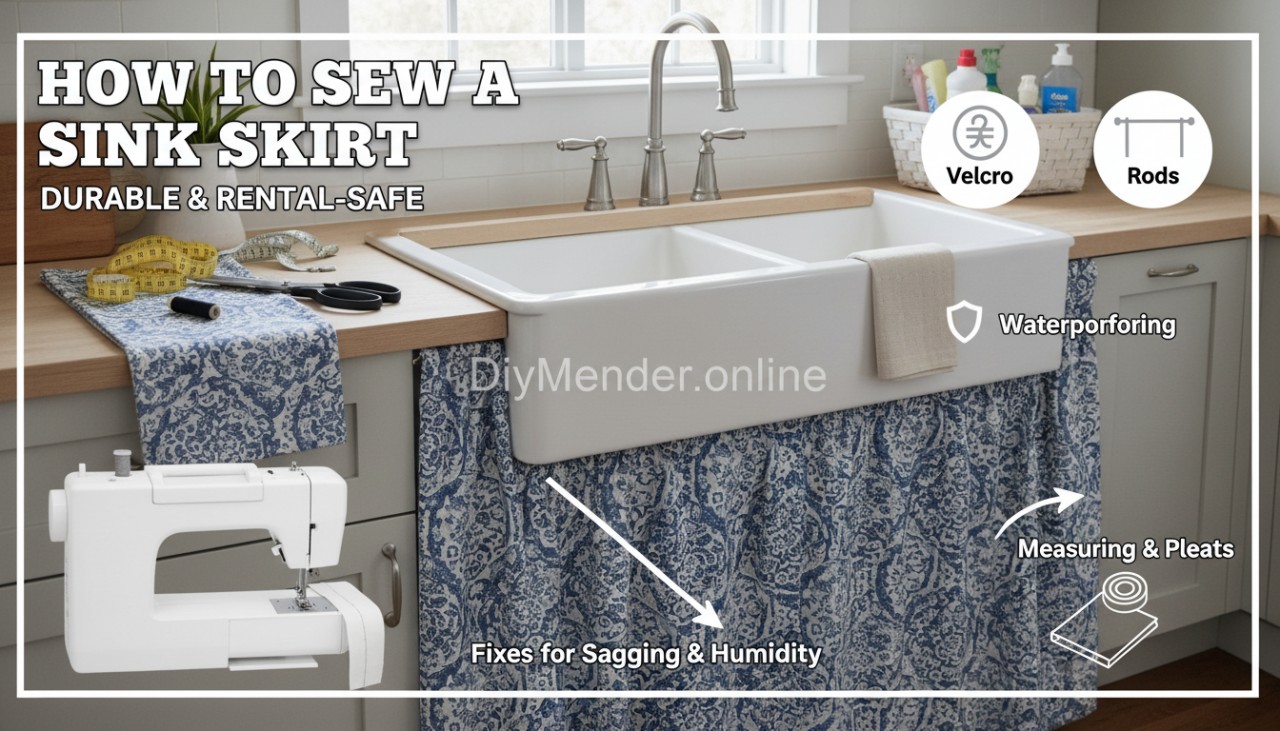
Here’s exactly how to sew a sink skirt that fits, stays put, and survives splashes: measure the opening, cut fabric wide enough for graceful fullness, hem three sides, add a header (Velcro header or rod pocket), then mount under the sink rim using adhesive hook-and-loop, a tension rod, magnets, or staples for wood. That’s the whole system for how to sew a sink skirt, and it works because you split the job into two dependable parts: a washable fabric panel and a mounting method suited to your surface and humidity.
Plan, Measure, and Choose Mounting
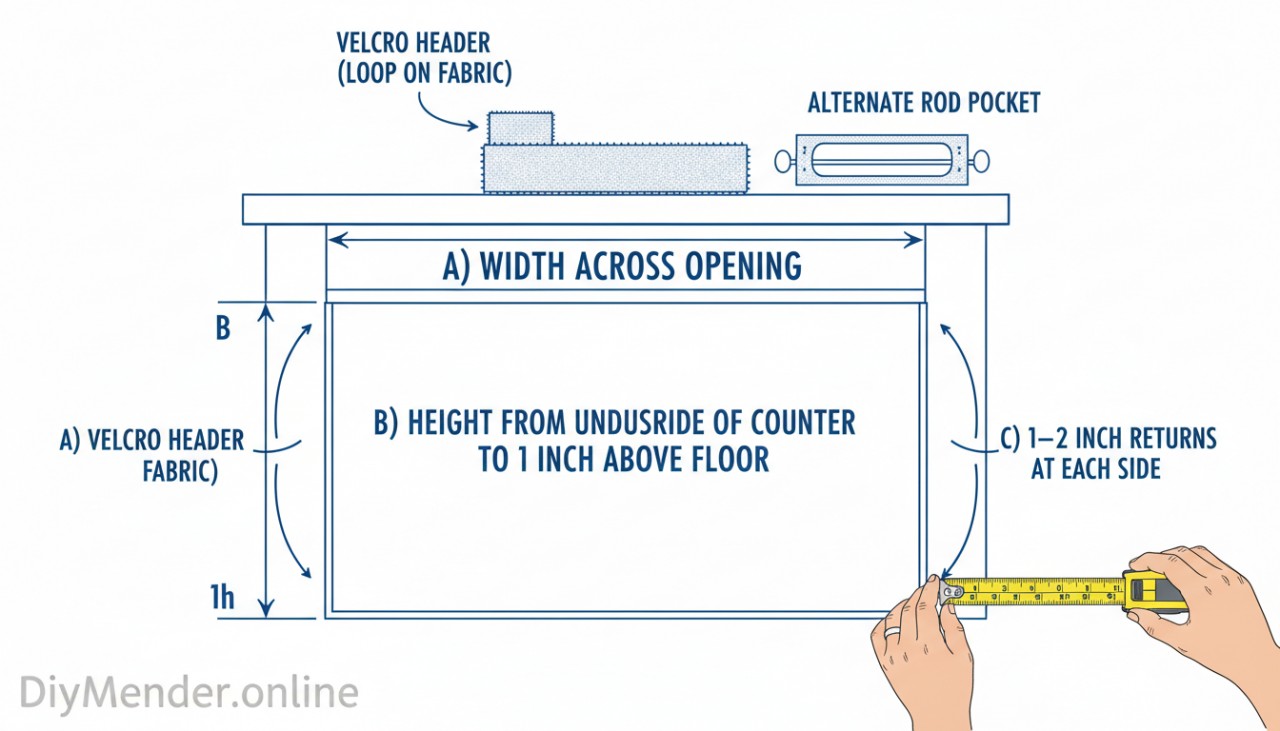
Measure the width of the opening you want to cover, then add returns (the small wrap-around at each side so you can’t see behind the skirt). I add 1–2 inches per side for returns. For height, measure from the underside of the counter or sink apron to your desired finished length, subtract 1/2–1 inch so it doesn’t wick water off the floor, then add 2 inches for a double-fold bottom hem and 1–2 inches for the header (Velcro tape or rod pocket).
For fullness, a sink curtain reads best at 1.5–2x the opening width. Example: a 30-inch opening with 2-inch returns per side becomes 34 inches, times 1.75 fullness = about 60 inches of panel width. If you prefer crisp pleats instead of soft gathers, plan 2–3 inches per pleat plus spacers, which typically lands near 1.75x fullness as well.
Fabric and Notions That Actually Last
- Medium-weight cotton duck, twill, linen blend, or performance/outdoor fabric: sturdy and washable.
- Oilcloth or laminated cotton: wipeable, but stiffer; avoid near heat sources.
- Sew-on loop tape (soft side) for the panel + industrial adhesive-backed hook tape for the cabinet/sink underside. Adhesive-backed loop on fabric will peel when washed.
- 1/2–1 inch hem tape or thread; universal needle size 90/14 for medium weights.
- Optional: lightweight interfacing for a crisp header; Scotchgard or Otter wax for splash resistance.
Mounting Options (Pick One Based on Your Surface)
- No-drill Velcro sink skirt: Stick the hook tape under the counter or sink apron; sew the loop tape to your skirt. Choose high-bond tape (3M VHB-backed hook or 3M Dual Lock) in humid baths.
- Tension rod: Sew a rod pocket; great inside a vanity or between side panels. Needs straight side walls.
- Magnets: If the cabinet face or apron is steel, stitch small rare-earth magnets into the header.
- Staples/screws into wood: Best hold, but not rental-friendly. Use a thin wood batten plus staples, then staple sew-on loop to the batten.
Cut and Sew the Panel
- 1) Prewash and dry your fabric the way you’ll launder it later. This prevents post-install shrink that causes a wavy hem.
- 2) Cut width to your calculated fullness plus 1 inch (1/2 inch side seam each side). Cut height to finished length plus 3–4 inches for hem and header.
- 3) Side seams: Press 1/2 inch to the wrong side twice; stitch. Double folds stop fraying and keep steam-humidity from lifting the edge.
- 4) Bottom hem: Press 1 inch twice; stitch. For heavy fabric, trim bulk at corners before the second fold.
- 5) Header for Velcro: Fuse a 1–2 inch strip of lightweight interfacing along the top on the wrong side. Fold the top edge to the back by 1 inch and stitch. Then sew the loop (soft) tape along the front face near the top edge, stitching both long edges of the tape. The interfacing keeps the header from sagging.
- 5-alt) Header for a rod pocket: Fold 2–3 inches to the back, stitch the bottom of the pocket first, then the top. Size the pocket about 1/2 inch bigger than the rod diameter.
- 6) Gathers or pleats: If you want gathers, run two parallel basting stitches across the header and draw up to your final width before sewing on the loop tape. For pleats, mark, fold, and press before stitching the header and tape.
- 7) Mounting: Clean the underside of the counter/apron with isopropyl alcohol. Stick the hook tape, press firmly for 30 seconds, and let it cure per manufacturer (often 24 hours) before hanging the skirt. For rod mounts, install the tension rod snug, then slide on the skirt.
Why This Works (and When It Doesn’t)
Separating the fabric panel from the mount lets you wash the skirt while keeping a robust anchor in place. Adhesive hook tape grips best to smooth, clean, non-porous surfaces; it fails on dusty or textured wood, and it can creep in steamy bathrooms unless it’s a high-bond adhesive and fully cured. A tension rod avoids adhesives but needs parallel, flat sides; in an out-of-square nook, it will slip. Interfacing at the header resists the downward pull of gathers, which is why skirts without it sag over time.
Common Mistakes and Fast Fixes
- Skirt wicks water from the floor: Raise the finished length by 1/2–1 inch, or add a hidden line of clear seam sealer to the hem.
- Adhesive Velcro falling: Clean with alcohol, warm the tape with a hairdryer while pressing, and allow cure time. Use VHB-backed hook tape and sew-on loop on fabric.
- Too little fullness: Add a second panel or insert a centered box pleat. A flat panel looks like a bedsheet; 1.5–2x reads intentional.
- Uneven hem on sloped floors: Mark hem while the skirt hangs in place; trim and re-hem to the visual level, not the bubble level.
- Rod slipping: Choose a rod with rubber ends and oversize it slightly. If walls are slick tile, stick clear Command strips where the rod ends touch.
Edge Cases and Workarounds
- pedestal sink skirt: Use adhesive hook tape around the underside of the basin rim; split the panel at center with overlapping pleats for access to the trap.
- Farmhouse/apron-front sink: Mount tape to the cabinet frame just under the apron, not the sink itself, to avoid bonding to firing glaze.
- Tile or stone underside: Adhesive may struggle; use a thin wood batten bonded with construction adhesive to the stone underside, then stick hook tape to the batten.
- Metal cabinet: Sew small magnets into the header, spaced every 4–6 inches. Add a fabric facing so magnets don’t print through.
- Rentals: Go no-drill Velcro or a tension rod inside the vanity so nothing is permanent.
Care and Maintenance
Wash cotton and linen on cold and line-dry to preserve size; re-press the header so gathers stay crisp. For wipeable options, spot-clean and reapply fabric protectant every few months. If you used magnet mounts, dry the header thoroughly to prevent any corrosion in damp rooms.
Time, Cost, and Materials
Expect 60–120 minutes once you’ve prewashed. Cost runs $15–$40 for fabric plus $8–$20 for quality hook-and-loop or a tension rod. Materials: fabric, thread, sew-on loop tape, adhesive hook tape (or tension rod/magnets), interfacing, measuring tape, scissors, iron, and sewing machine.
Quick Variations
- No-sew option: Use fusible hem tape for sides and bottom; stick-on loop is tempting but don’t—use sew-on loop with hem tape and stick hook to the cabinet.
- Center-split skirt: Two overlapping panels give easy access to trash or cleaners under the sink.
- L-shaped vanity: Make two panels and meet them at the inside corner with a small overlap.
Follow the steps above and you’ll have a tailored, durable, rental-friendly sink skirt that looks intentional, hides clutter, and stands up to everyday splashes.