If you’re asking what size is a kitchen sink drain pipe, you probably want to buy the right parts the first time and avoid leaks. Here’s the short, practical breakdown based on what you’ll actually see under most sinks.
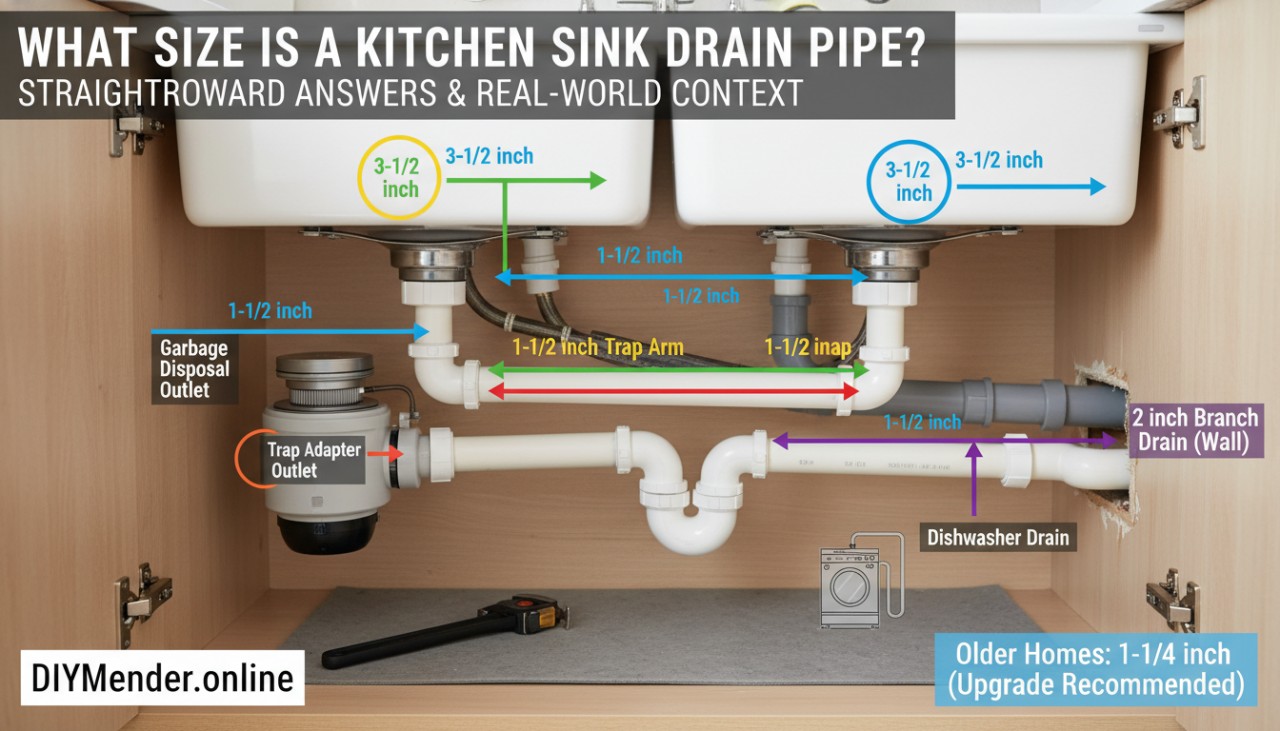
Quick answer: Most kitchen sinks have a 3-1/2 inch drain opening with a basket strainer. The tubular tailpiece and P-trap are 1-1/2 inch. The trap arm usually runs 1-1/2 inch into the wall, where it ties into a 2 inch branch drain. Garbage disposals fit the same 3-1/2 inch opening and use a 1-1/2 inch outlet. Older homes may have 1-1/4 inch traps—upgrade if you can.
What those sizes mean and where they go
• Drain opening at the sink: Most sinks are 3-1/2 inches across and accept a standard basket strainer or a garbage disposal flange. That size doesn’t change your pipe size; it’s just the hole in the sink.
• Tailpiece: The short vertical tube under the strainer (or disposal) is usually 1-1/2 inch tubular.
• P-trap: Nearly always 1-1/2 inch tubular for a kitchen sink. This is what blocks sewer gas and catches debris.
• Trap arm: The horizontal piece from the trap to the wall is typically 1-1/2 inch tubular, which then connects to a trap adapter at the wall.
• Branch drain in the wall: Often 2 inches (schedule 40), especially by current codes, because kitchen sinks see grease and food particles. Your wall fitting likely steps up here.
Why pipe size matters
Getting sizes right prevents three problems: leaks at slip-joint nuts, slow drains from undersized parts, and clogs from poor transitions. Kitchen sinks handle grease and food particles, so the system needs enough diameter to move waste and keep the trap sealed. Codes commonly require a 2 inch branch drain for this reason—even if the visible trap is 1-1/2 inch.
Common setups (with and without a disposal)
Standard sink, no disposal
• 3-1/2 inch basket strainer
• 1-1/2 inch tubular tailpiece
• 1-1/2 inch P-trap and trap arm
• Trap adapter at the wall converting to 2 inch schedule 40
Sink with garbage disposal
• Disposal flange fits a 3-1/2 inch opening
• Disposal outlet is 1-1/2 inch, connecting to a 1-1/2 inch P-trap
• Dishwasher hose (if present) connects to the disposal or an air gap; hose barb is usually 5/8 inch or 3/4 inch
Double-bowl sink
• Two 1-1/2 inch tailpieces merged with a baffle tee or a center outlet kit
• Single 1-1/2 inch P-trap serving both bowls
Tubular vs schedule 40: the sizing gotcha
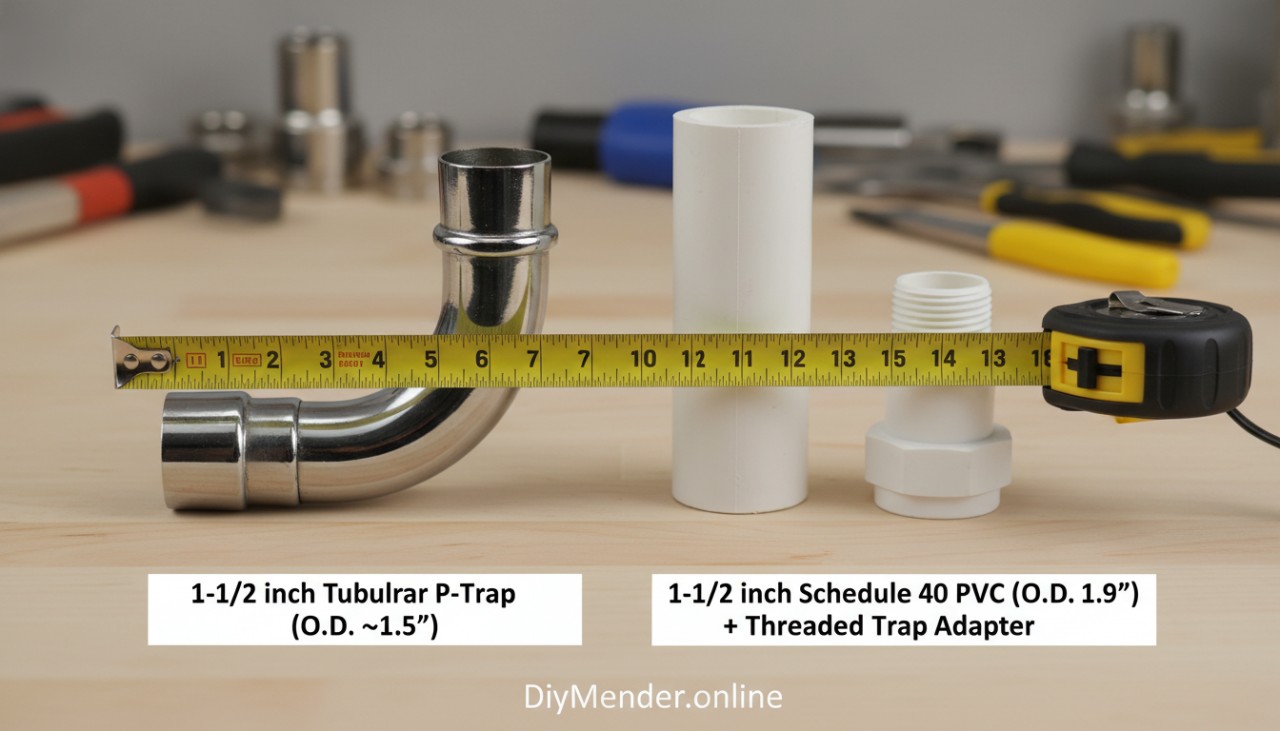
Under-sink parts you buy in a kit are usually “tubular” (thin-wall) and sized by outside diameter. 1-1/2 inch tubular has an outside diameter of about 1.5 inches. Schedule 40 PVC is “nominal”: 1-1/2 inch schedule 40 has an outside diameter of about 1.9 inches. That’s why you need a trap adapter fitting at the wall to connect tubular to schedule 40 without leaks.
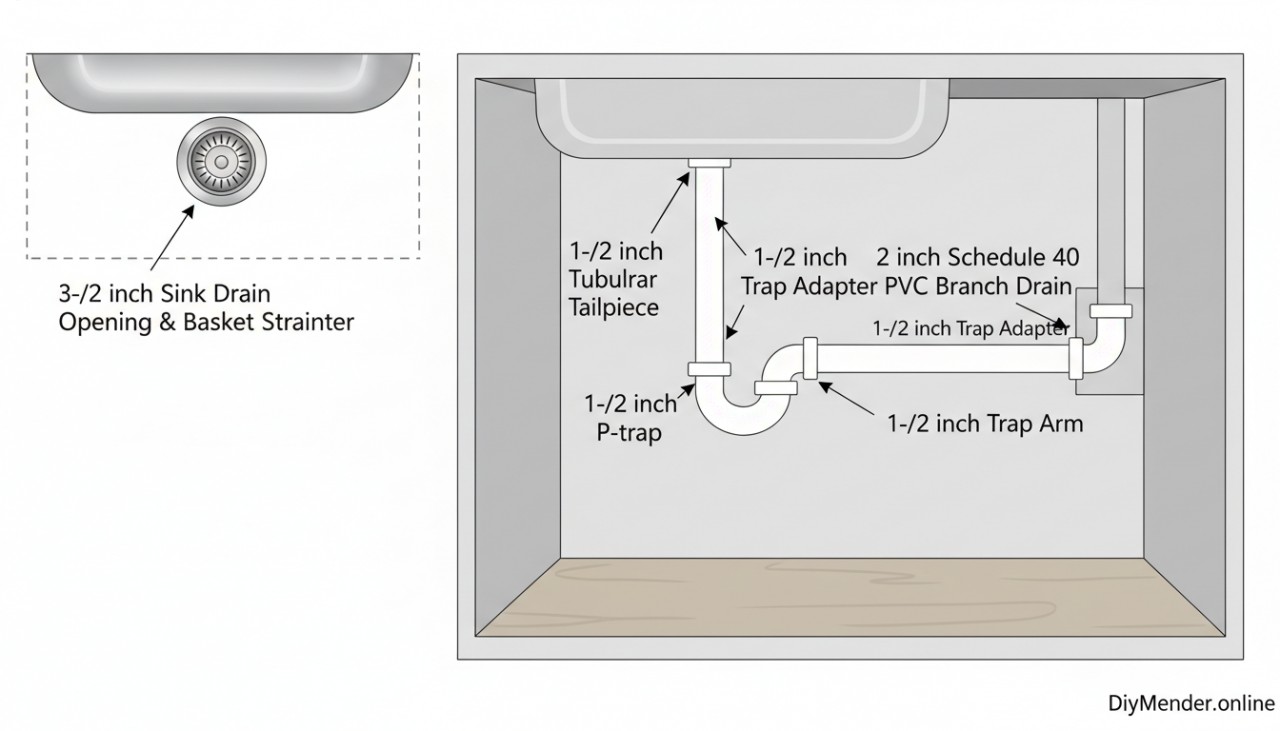 sink drain opening with basket strainer, 1-1/2 inch tubular tailpiece, 1-1/2 inch P-trap, 1-1/2 inch trap arm connecting to a wall-mounted trap adapter, and a 2 inch schedule 40 PVC branch drain behind the wall; include labels, arrows, and callouts for each component; neutral lighting, clean under-sink cabinet; watermark: DiyMender.online in a small, readable corner" title="Detailed labeled illustration of a kitchen sink plumbing setup: top view and cutaway under-sink view, showing a 3-1/2 inch sink drain opening with basket strainer, 1-1/2 inch tubular tailpiece, 1-1/2 inch P-trap, 1-1/2 inch trap arm connecting to a wall-mounted trap adapter, and a 2 inch schedule 40 PVC branch drain behind the wall; include labels, arrows, and callouts for each component; neutral lighting, clean under-sink cabinet; watermark: DiyMender.online in a small, readable corner" class="overly-article-img">
How to measure what you have
• Measure the sink opening from rim to rim: most are 3-1/2 inches.
• Check the trap: if it looks thin-wall with slip nuts, you likely have 1-1/2 inch tubular. If it’s thick white PVC glued pipe, it’s probably schedule 40.
• At the wall, look for a trap adapter: a plastic or brass fitting with slip threads. If you only see a glued hub, you may need to glue in an adapter.
• If your trap measures closer to 1-1/4 inch tubular (common in older bathrooms), consider upgrading to 1-1/2 inch for a kitchen sink if the wall connection allows.
When 2 inch matters at the wall
Many jurisdictions require a 2 inch branch drain for a kitchen sink because of grease load and dishwasher/disposal discharge. Even if your visible trap is 1-1/2 inch, the wall line often steps up to 2 inch. If you open the wall or are remodeling, it’s smart to confirm and upgrade if needed.
Picking the right parts at the store
• Basket strainer for a standard sink: 3-1/2 inch
• P-trap kit: 1-1/2 inch tubular, with extra extension tube if needed
• Baffle tee for double sinks: 1-1/2 inch tubular
• Trap adapter: 1-1/2 inch slip-joint by 1-1/2 inch or 2 inch schedule 40 (match the wall fitting)
• Plumber’s putty for the strainer (unless the manufacturer calls for a gasket or silicone)
• New slip-joint washers (conical or beveled) and a few spare nuts
Simple assembly tips
• Dry-fit everything first. Keep the trap level and the trap arm with a slight pitch toward the wall.
• Use the correct washer orientation: thick side toward the nut, tapered side toward the joint.
• Hand-tighten slip nuts, then give a gentle quarter-turn with pliers—no more.
• Run water and check each joint with a dry tissue for weeps.
Special cases
Older 1-1/4 inch traps
If you find a 1-1/4 inch trap under a kitchen sink, it’s undersized by today’s standards. Upgrade to 1-1/2 inch tubular and, if needed, use the correct trap adapter to mate with the wall fitting or replace the wall arm to 2 inch where practical.
Disposal and dishwasher hookups
Knock out the disposal’s dishwasher plug before connecting the hose. Use a high loop or an air gap as required locally. Dishwasher hoses are typically 5/8 inch or 3/4 inch—match the barb and secure with a worm clamp.
Venting
A properly vented trap is critical. If the sink gurgles or the trap siphons dry, the vent may be missing or blocked. An AAV (air admittance valve) is sometimes allowed, but check local rules.
When to call a pro
• Repeated clogs despite correct sizing
• No visible trap adapter and only glued fittings in the cabinet
• Signs of improper venting or sewer gas smells
• You need to upsize the branch drain to 2 inch inside the wall
Prevention and best practices
• Avoid pouring grease down the sink; wipe pans with a paper towel first.
• Use a strainer basket to catch solids.
• Periodically check slip nuts and washers for weeping and retighten lightly.
• If redoing cabinets or counters, confirm the rough-in height so the trap lines up without extreme angles.
FAQ
Is 1-1/2 inch always correct for the trap?
For a kitchen sink, yes in nearly all cases. The trap and tubular parts are typically 1-1/2 inch. Bathroom sinks are usually 1-1/4 inch.
Do I need 2 inch pipe anywhere?
Often yes, inside the wall for the branch drain. Many codes call for a 2 inch kitchen sink drain line, especially with a dishwasher or disposal.
Can I connect 1-1/2 inch tubular to 1-1/2 inch PVC directly?
No. You need a trap adapter because 1-1/2 inch tubular and 1-1/2 inch schedule 40 have different outside diameters.
What size is a standard sink strainer?
3-1/2 inches across the sink opening. Nearly all modern sinks use this size.
Should I use Teflon tape on slip-joint threads?
No. Slip joints seal on the washer, not the threads. Keep the threads clean and the washers seated properly.
A quick way to sanity-check your setup
Look for 1-1/2 inch tubular from the sink (or disposal) through the trap and into a trap adapter, then a 2 inch PVC line in the wall. If that’s what you have, you’re in the normal, code-friendly range and can assemble confidently without oddball fittings.
Get the sizing right once, and your sink will drain smoothly with fewer clogs and no mystery leaks under the cabinet.