
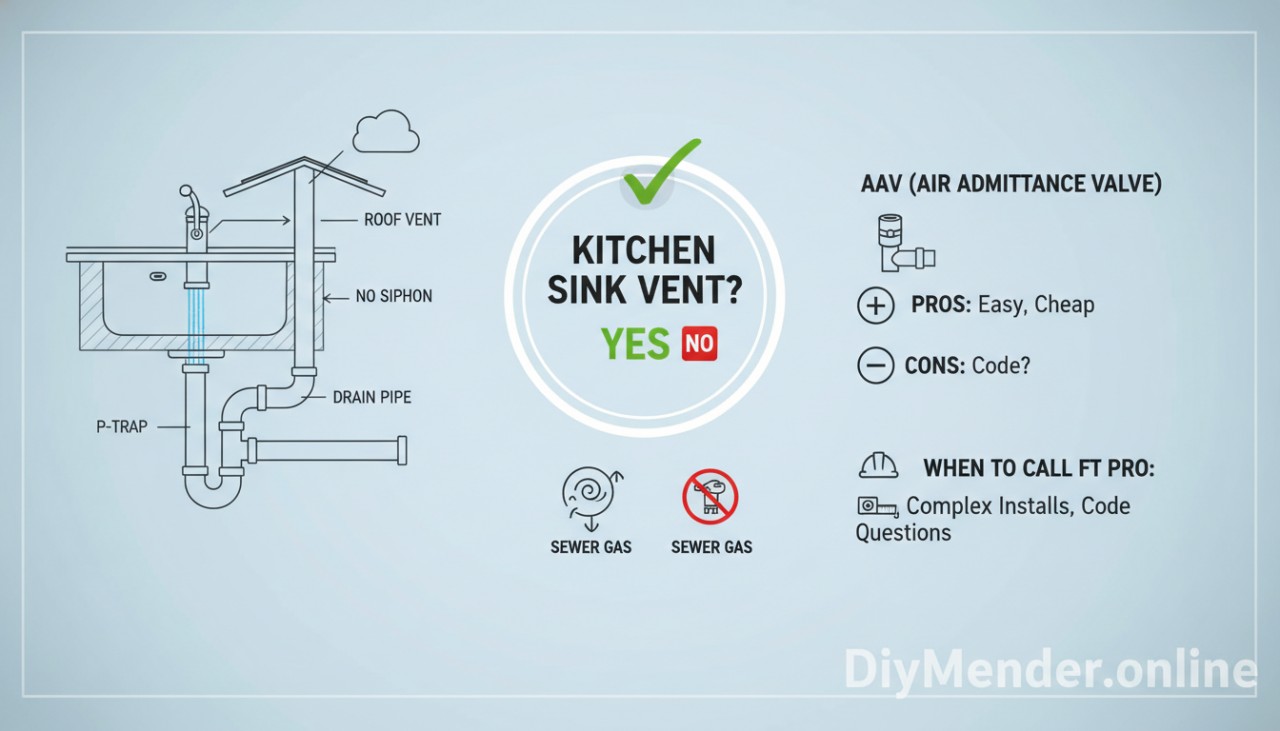
If you’re asking does kitchen sink need a vent, the short answer is yes—every sink needs proper venting so the trap holds water and sewer gas stays out of your home. How you vent it can vary, but skipping a vent leads to slow drains, gurgling, and smells that only get worse.
does kitchen sink need a vent
Yes. A vent lets air follow wastewater so your P-trap isn’t siphoned dry. Without air behind the draining water, the pipe pulls a vacuum, the trap seal drops, and you invite sewer gas, pests, and moisture into the kitchen. Building codes everywhere require kitchen sink venting; the methods differ by layout and local rules.
What the vent actually does
Think of the drain as a straw. Put your finger over the top and the liquid won’t flow because air can’t get in. A plumbing vent opens the system to air so waste moves freely and the water seal in the P-trap stays put. The trap seal depth (typically 2–4 inches of water) is your only barrier to sewer air. Good venting protects that seal during every drain cycle and any pressure changes in the stack.
Common ways a kitchen sink is vented
- Conventional vent: The trap arm runs to a vertical drain that connects to a vented stack or has a vent takeoff that rises vertically, then ties into the main vent through the roof.
- Air admittance valve (AAV): A mechanical valve that opens to admit air on negative pressure and seals otherwise. Often used under the sink when no vertical vent is available. Allowed in many areas under the International Plumbing Code but often restricted or prohibited under the Uniform Plumbing Code—check your local inspector.
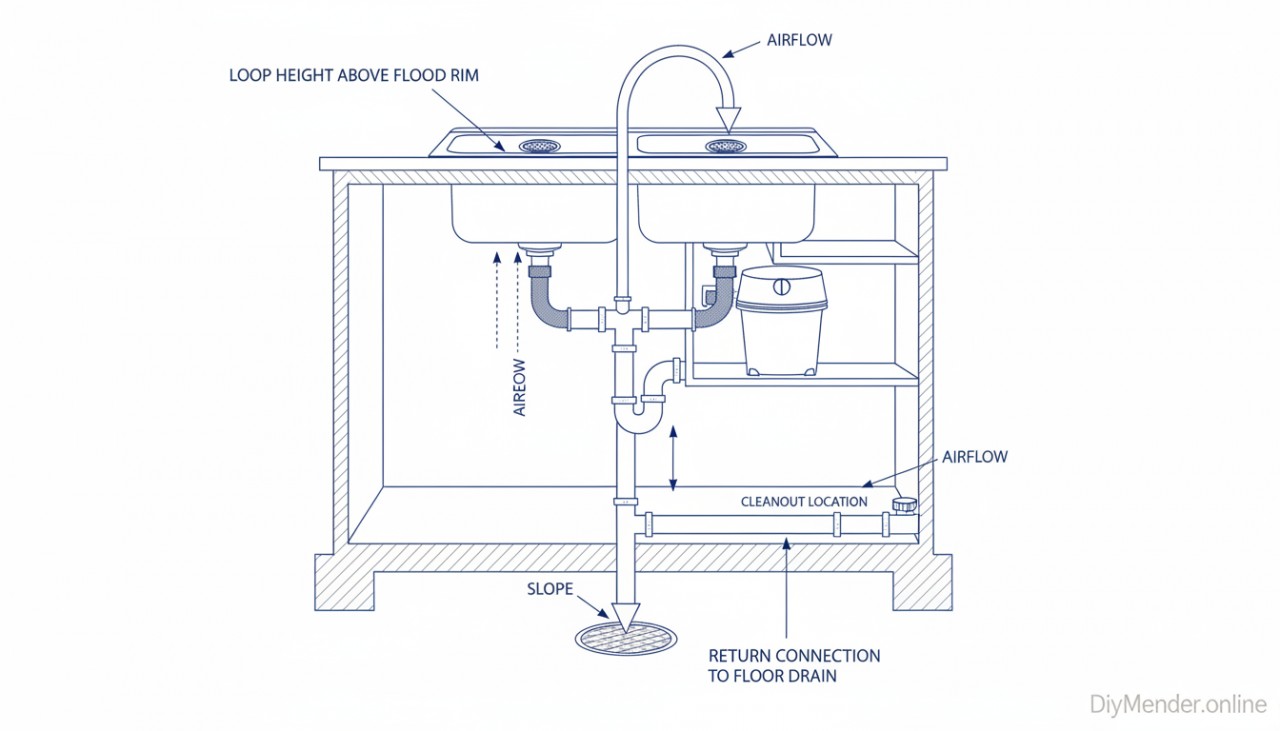
- Island loop vent: A special loop of pipe under an island sink that rises as high as possible before returning to the floor drain line, with a vent connection back to the stack. It has no roof penetration at the island but is a true vented system if built to code.
- Wet venting (in bathrooms): Not typical for kitchens, but in some designs a properly sized and configured drain for another fixture can share venting. Kitchens usually need their own vent method.
How far can the vent be from a kitchen sink?
The trap arm (the horizontal run from the trap to the vented line) has a maximum length based on pipe diameter and your local code. In practice, with 1.5-inch kitchen drain pipe:
- Many IPC jurisdictions allow up to about 6 feet if the slope is correct and fittings are right.
- Many UPC jurisdictions limit it to about 3–5 feet, often on the shorter side.
These numbers vary, and fittings, slope, and elevation changes matter. If you keep the vent takeoff within 3–4 feet on 1.5-inch pipe, you’ll usually be safe, but confirm locally. The trap arm must have a continuous fall (commonly 1/4 inch per foot). If the run is longer or drops too fast, the trap can self-siphon even with a vent.
When an AAV is a reasonable choice
I’ve used AAVs on remodels where adding a roof vent wasn’t realistic. They work, but they’re not magic:
- Pros: Easy to add, avoids roof work, inexpensive, and often quiets gurgling immediately.
- Cons: Mechanical parts can fail over time, not allowed everywhere, can’t relieve positive pressure (they only admit air), and must remain accessible for inspection and replacement.
- Placement: Mount on a vertical stub at least 4 inches above the trap arm and above the drain line’s weir; keep it upright and accessible with an air path (don’t box it in airtight).
Always ask your local building department if AAVs are permitted. If not, consider an island loop or conventional vent.
Island sinks and other tricky layouts
An island vent loop takes planning but avoids mechanical valves. The loop rises as high as possible under the countertop before turning down and connecting to a vented line elsewhere. The key is height: the top of that loop must be above the sink’s flood rim elevation so it never becomes a siphon path.
Signs your sink isn’t vented properly
- Gurgling after the basin drains or when the dishwasher pumps out.
- A “glug-glug” from the trap and occasional sewer odor under the sink.
- Slow drainage that improves if you crack open a cleanout or remove the AAV cap temporarily (test only briefly).
- Water pulled out of the trap (you’ll find the trap dry or the smell gets worse after big drain events like emptying a full sink).
These symptoms can also come from partial clogs. I clear the line first (hand auger or proper drain cleaning) before deciding it’s a vent issue.
Code red flags I see in real homes
- S-traps: A trap that drops straight down after the trap weir is almost guaranteed to siphon. Replace with a P-trap and a proper vent or AAV where allowed.
- AAV buried in a wall: They must be accessible and have room for air. Don’t drywall over them.
- Double trapping: A disposal with a second trap or a second trap downstream confuses flow and airflow. Only one trap per fixture drain.
- Flat or back-sloped trap arm: Water pools, clogs build, and venting becomes ineffective. Maintain proper slope.
- Improper tees: A sanitary tee laid on its back for horizontal-to-horizontal connection can cause blockage and poor venting. Use a wye or combo fitting for flow direction.
Garbage disposals and dishwashers
Disposals don’t replace a vent. They can actually make poor venting obvious because they push water fast. For dishwashers, keep the drain hose with a high loop (or air gap where required) to prevent backflow; that’s separate from venting but helps avoid siphoning the dishwasher. If the sink gurgles when the dishwasher runs, you likely have a venting or partial clog issue.
Quick diagnostic steps
- Listen test: Fill the sink, then drain it. If you hear gurgling and smell odors, suspect the vent.
- AAV check: If you have an AAV, gently tap it or temporarily unscrew and reseat it. If performance changes, the valve may be sticking. Replace if in doubt.
- Cleanout test: Briefly crack a nearby cleanout cap while draining. If the sink drains faster, your system is starving for air or has a blockage further down.
- Trap inspection: Remove and clean the P-trap. If it’s packed with debris, fix that first before changing venting.
How I add or improve venting in a remodel
- Confirm local code path: Roof vent, AAV, or island loop allowed? Call the building department early.
- Measure trap arm length and slope: Keep it short and properly pitched. If too long, move the vent closer.
- Choose fittings correctly: Use a wye or combo for horizontal connections. Vent takeoff should be above the centerline of the drain.
- AAV install basics: Add a vertical stub off the drain after the trap, mount the AAV high (above the trap arm), keep it upright, and leave an access panel if it’s in a cabinet.
- Pressure/flow test: Run the faucet full blast, then drain a full basin. No gurgling, no odor, no trap movement should be the result.
When to call a pro
If you need to open walls, re-route a stack, or your jurisdiction doesn’t allow AAVs, bring in a licensed plumber. Also call a pro if you have repeated sewer gas odors despite a seemingly correct setup—that can signal a larger vent stack blockage or a cracked pipe in the wall.
Practical rules of thumb that keep me out of trouble
- One trap per sink, and no S-traps.
- Keep the vent connection within a few feet of the trap for 1.5-inch pipe (check your local max distance).
- Maintain 1/4 inch per foot slope on the trap arm.
- Use an AAV only where allowed, and keep it accessible and upright.
- For islands, plan the loop early and get it as high as possible under the counter.
- If the sink gurgles after clearing clogs, you still have a venting problem.
Bottom line
Your kitchen sink absolutely needs a vent, whether it’s a conventional stack connection, an approved AAV, or a properly built island loop. Good venting protects the trap seal, prevents odors, and makes drains fast and quiet. Do the simple checks, respect the distance and slope rules, and don’t hesitate to get an inspection or help if you’re pushing the limits of your layout.