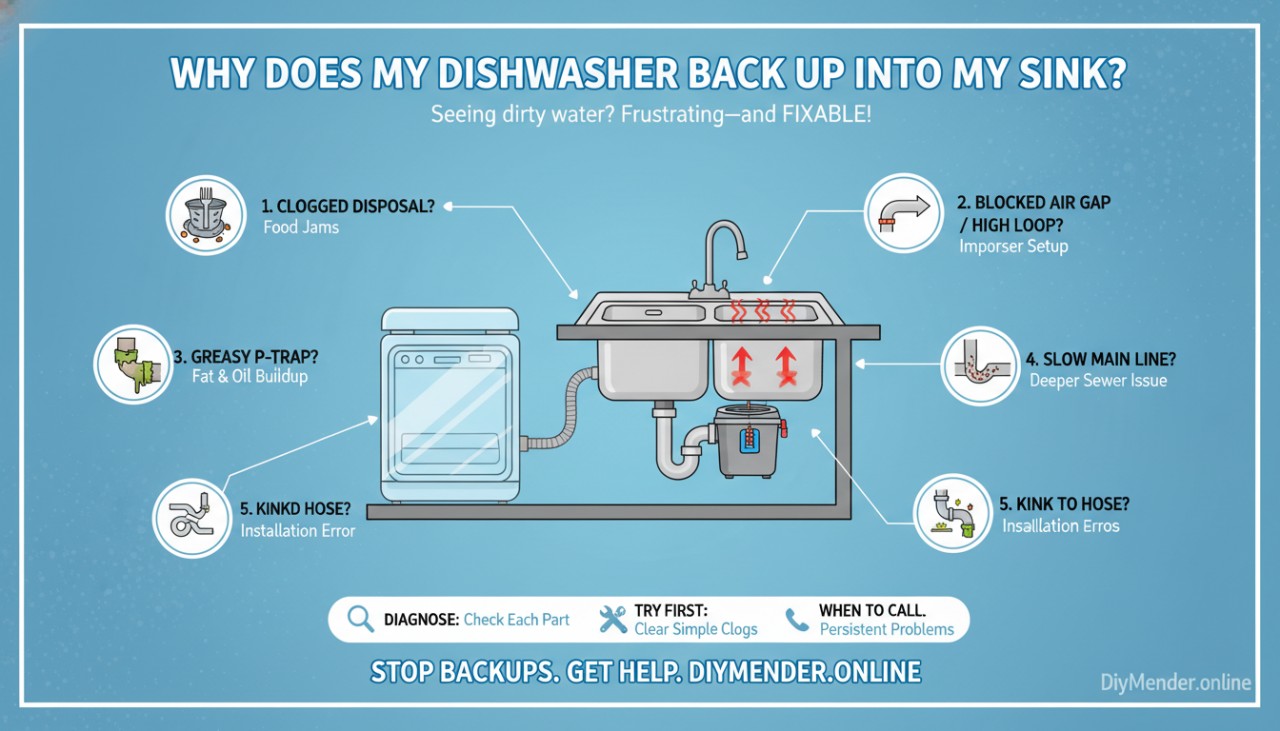
If you’re wondering “why does my dishwasher back up into my sink,” you’re watching the dishwasher’s drain water find the first open path—usually the kitchen sink—because something downstream is restricted. The fix is almost always in the drain path under the sink, not inside the dishwasher.
Quick answer
Dishwasher water backs up into the sink when the shared drain path is blocked or poorly vented. The usual culprits are a clogged garbage disposal inlet, grease-packed P-trap, a blocked air gap or missing high loop, a kinked or clogged dishwasher drain hose, or a slow main drain. Start by clearing the disposal and P-trap, then check the hose and air gap/high loop.
What’s actually happening
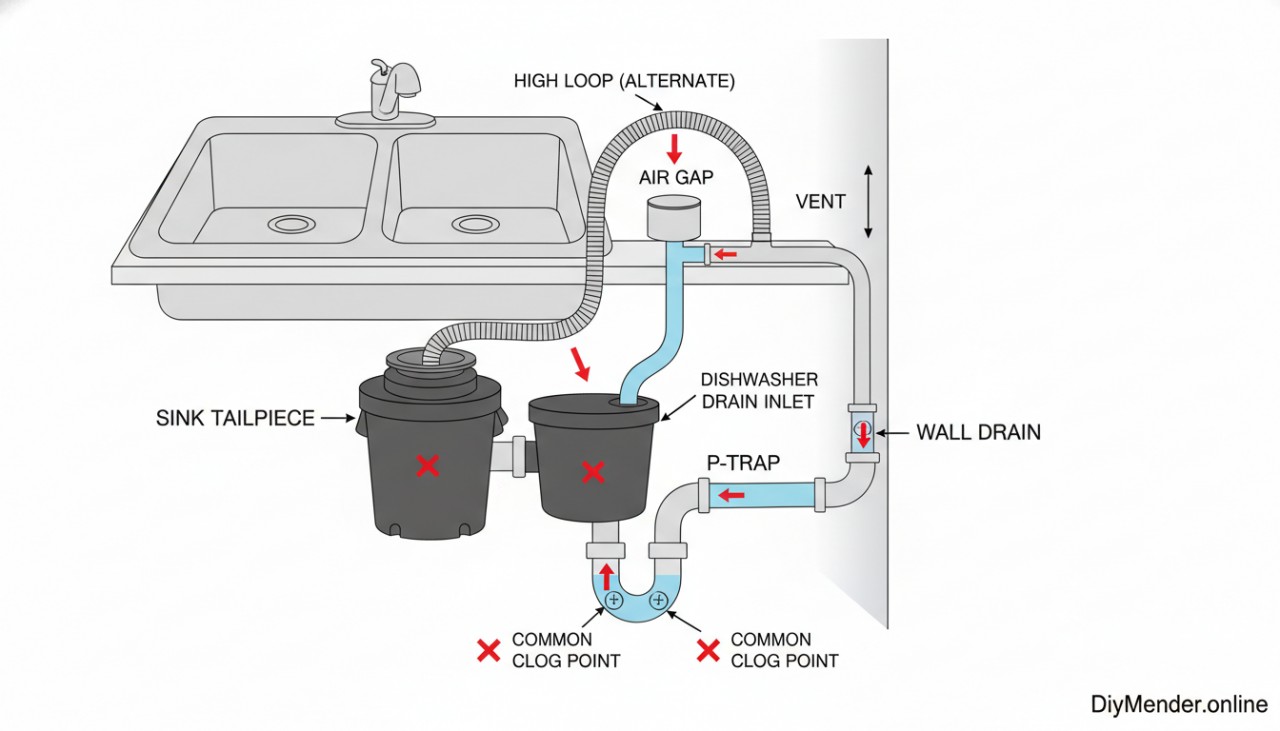
Your dishwasher pumps out wastewater through a flexible hose. That hose either connects to an air gap on the sink deck or to a high loop under the counter, then into the garbage disposal or sink drain tailpiece, through the P-trap, and into the home’s drain. When any point after the hose connection can’t pass water quickly, the discharge backs up into the sink.
Why it backs up: likely causes
- Clogged garbage disposal inlet or disposal chamber (food sludge, peels, coffee grounds).
- P-trap packed with grease or debris right under the sink.
- Blocked or missing air gap, or a low/high loop issue that lets water run the wrong way.
- Kinked or clogged dishwasher drain hose.
- Slow or partially blocked main kitchen drain line in the wall.
- New disposal installed but the dishwasher knockout plug wasn’t removed.
Start with the simplest checks
1) Clear and test the garbage disposal
Run cold water and the disposal for 20–30 seconds. If it sounds labored or you see water rise in the sink, the disposal or its outlet is restricted. Unplug the disposal, inspect the chamber with a flashlight, and remove visible debris with tongs. Do not put your hand inside.
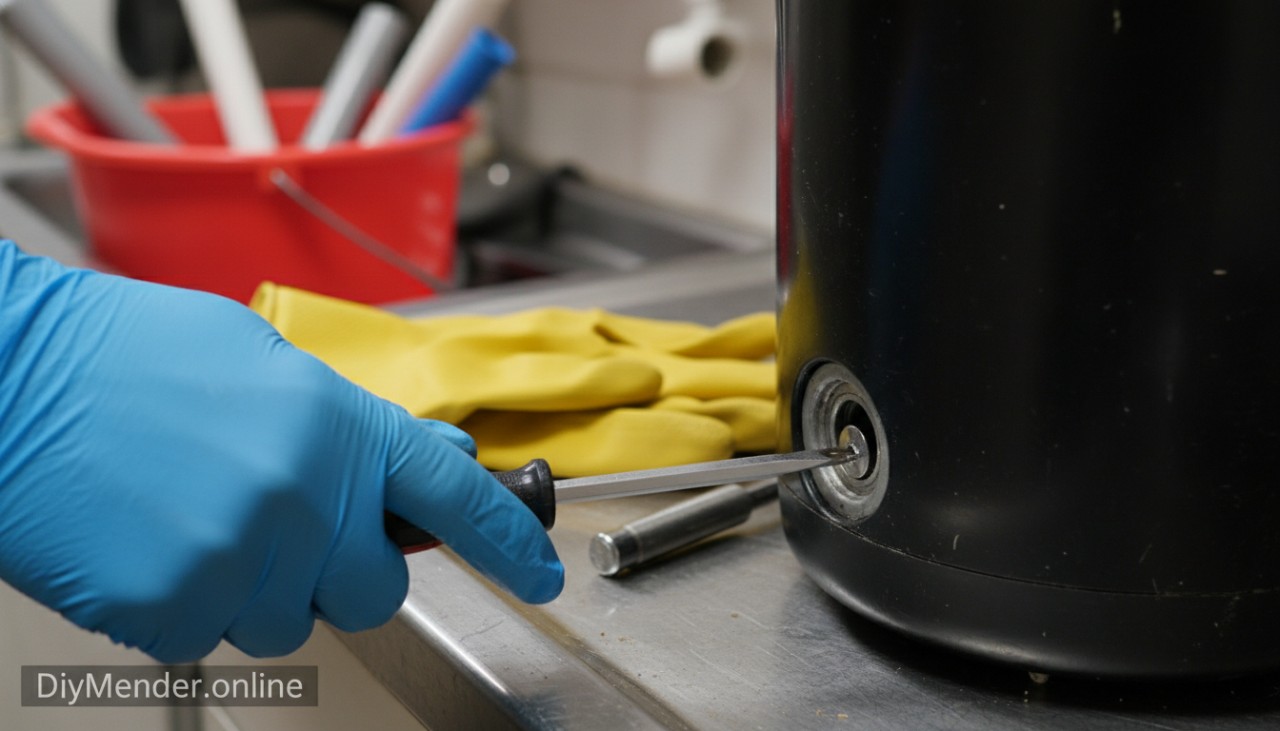
Next, check the small hose nipple on the side of the disposal where the dishwasher hose connects. If you recently installed the disposal, make sure the plastic knockout plug inside that nipple was punched out. Use a flat screwdriver and light taps with a hammer to remove it, then pull the loose plastic out from inside the disposal.
2) Flush the sink drain
With the disposal running and cold water flowing, see if water now drains freely. If the sink still fills when the dishwasher drains, the issue is likely in the P-trap or the wall drain.
Open the drain path: step-by-step
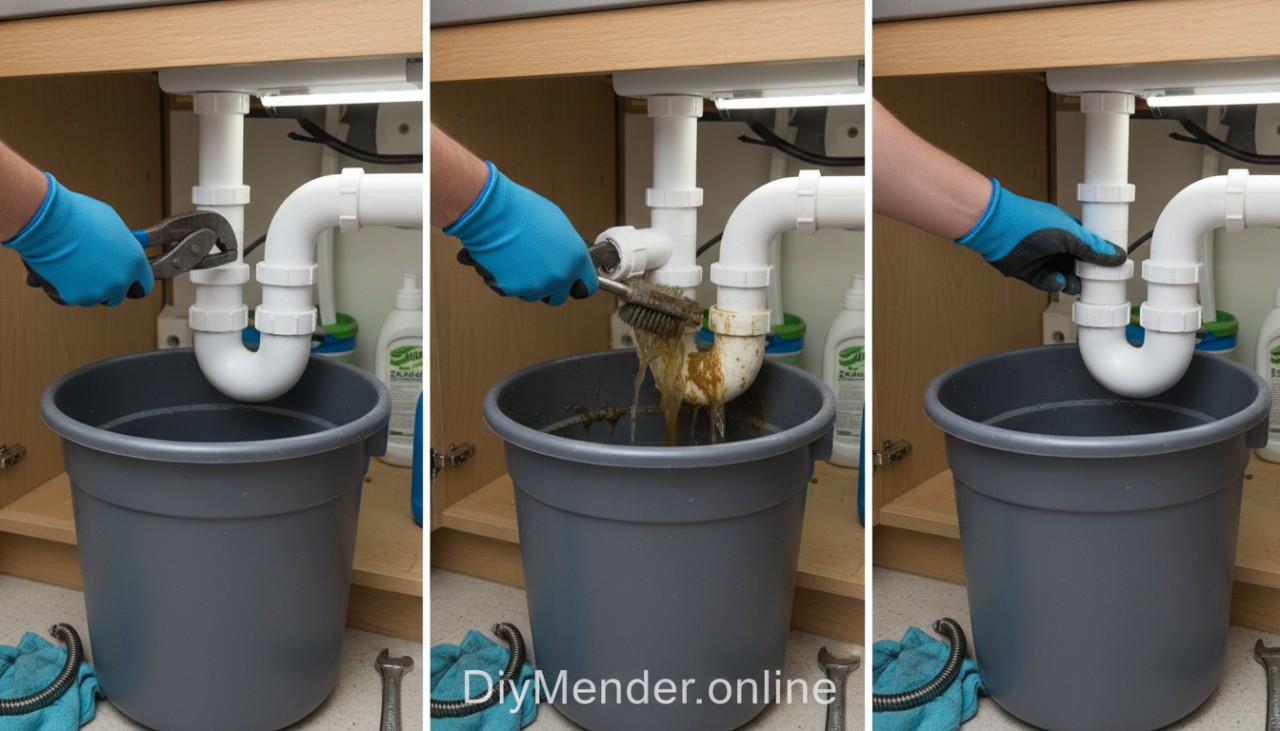
3) Clean the P-trap and trap arm
Safety: Place a bucket under the trap and wear gloves. Wastewater can be dirty and may contain sharp bits.
- Loosen the slip nuts on both ends of the P-trap (the U-shaped section). Catch water in the bucket.
- Dump the trap and remove sludge with a bottle brush or old toothbrush.
- Check the straight trap arm going into the wall. If it’s gunky, feed a small hand auger (drain snake) a couple of feet into the wall pipe and retrieve debris.
- Reassemble, aligning washers correctly. Hand-tighten, then give each nut a small additional turn—snug, not overtight.
- Run hot water to test for leaks and flow.
4) Inspect the dishwasher drain hose
Follow the hose from the dishwasher to the air gap or disposal. Look for kinks, sharp bends, or crushed sections. Detach the hose at the sink side and blow through it or flush it with warm water. If it’s full of grease or looks brittle, replace it—it’s inexpensive and often the root of slow drainage.
5) Air gap or high loop check
If you have an air gap on the sink deck (a small chrome “cap”), pull the cap and check for debris. Clean the two ports with a brush and warm water. If you don’t have an air gap, the hose should be secured in a high loop under the counter, rising as high as possible before dropping to the disposal. A low hose can siphon sink water into the dishwasher or allow backup to reach the sink more easily.
6) Evaluate the wall drain if backups persist
If the P-trap is clean and the hose is clear, the kitchen branch line in the wall may be restricted by years of grease and soap scum. A hand auger can clear the first few feet, but recurring slow drains usually need a professional auger or hydro-jetting to fully restore the pipe’s diameter.
How to choose what to try first
- New disposal installed? Confirm the knockout plug is removed before anything else.
- Sink drains fine until the dishwasher runs? Focus on the disposal inlet, air gap, and hose.
- Both sink and dishwasher slow all the time? Clean the P-trap and consider the wall drain.
- Intermittent issues after heavy cooking? Grease buildup—do a full trap and hose clean.
When to call a pro
- You’ve cleaned the disposal, P-trap, and hose, and it still backs up.
- Multiple fixtures in the kitchen or nearby bath are slow or gurgling (sign of a bigger drain issue).
- You smell persistent sewer gas (possible venting problem or dried traps).
- Old galvanized or cast-iron pipes that keep clogging (they may be scaled and need replacement).
Prevention and long-term habits
- Scrape plates, don’t rinse grease down the sink. Wipe oily pans with a paper towel before washing.
- Run the disposal with cold water for 10–15 seconds before and after the dishwasher drains.
- Once a month, flush the sink with very hot water. For maintenance, a half cup of baking soda followed by a cup of hot vinegar can help loosen light buildup—avoid harsh chemical drain cleaners on kitchen traps.
- Keep a proper high loop or a working air gap. Re-secure the hose if it sags.
- Replace old, soft, or grease-laden drain hoses every few years.
Real-world example
In one rental I manage, the dishwasher flooded the sink every third cycle. The disposal ran, the trap looked fine, and the hose wasn’t kinked. The culprit was the air gap: pasta bits wedged in the outlet port. A two-minute clean fixed it. A year later, backups returned—this time the wall line had a grease ring. A quick auger cleared it completely. Two different causes, same symptom.
FAQ
Why does the sink fill only when the dishwasher drains?
The dishwasher pump moves water fast, overwhelming a partially blocked path. Normal faucet flow may seem fine, but the higher volume exposes the restriction.
Can a clogged vent cause this?
Rarely in isolation. Venting issues usually cause gurgling and slow drains in multiple fixtures. Most kitchen backups trace to the disposal, P-trap, hose, or branch line.
Do I need an air gap if I have a high loop?
An air gap is the most reliable backflow prevention and is required in some areas. A high loop is better than nothing but can’t prevent all back-siphon scenarios.
Is it safe to use drain cleaner?
Chemical drain cleaners can damage gaskets and traps and are risky to handle when you later disassemble plumbing. Mechanical cleaning (trap removal, auger) is safer and more effective.
What if water backs into the dishwasher instead?
That points to a missing/low high loop or blocked air gap allowing sink water to flow back. Correct the hose height or clean the air gap.
Wrap-up
Most sink backups during a dishwasher drain are solved by clearing the disposal inlet, cleaning the P-trap, and ensuring the hose and air gap/high loop are right. Work from the sink outward: disposal, trap, hose, then wall line. A few careful checks usually restore smooth, quiet draining—and keep the dirty water where it belongs.