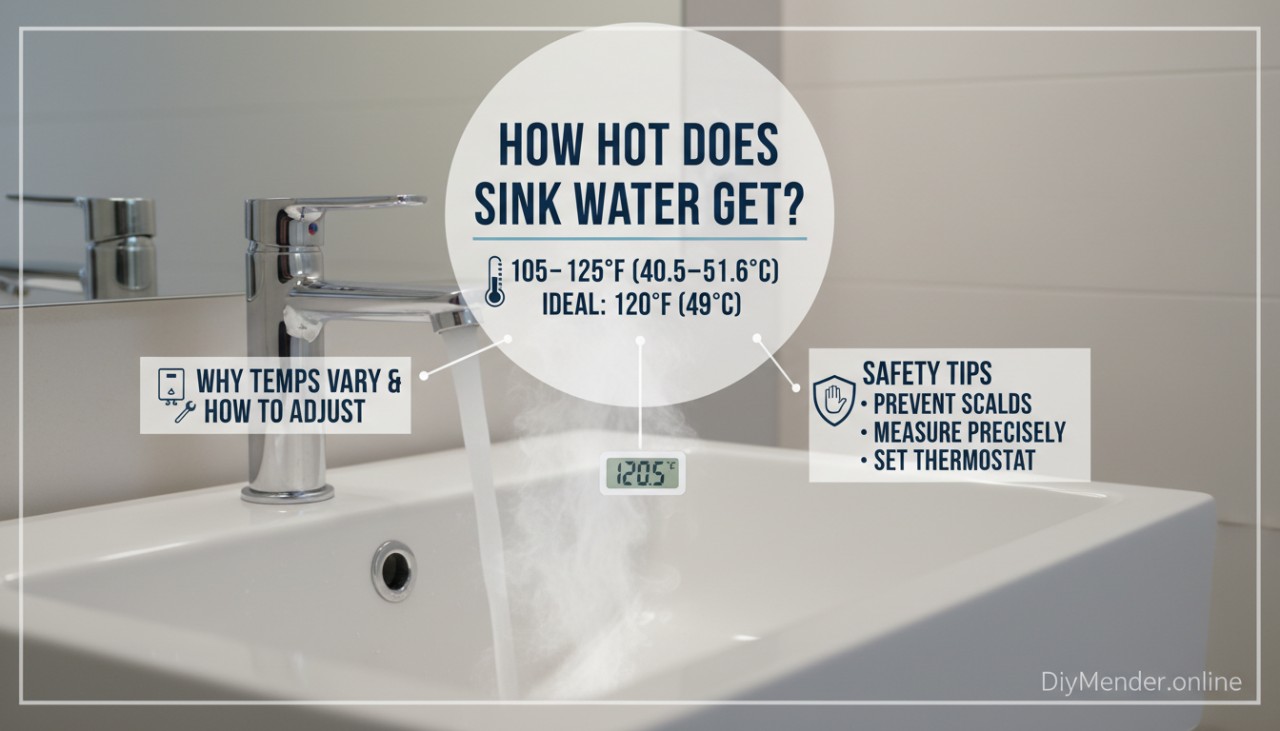
If you’re wondering how hot does sink water get, here’s the straight answer: at the faucet, most homes see 105–125°F (41–52°C) after 30–90 seconds of running, with 120°F as the sweet spot for comfort and scald safety. Many building codes limit bathroom lavatories to 120°F max. Kitchen sinks may be hotter, but anything above 130°F raises scald risk fast (140°F can cause severe burns in 5 seconds). If your faucet never hits 110°F or blasts beyond 130°F, you’ve got an adjustment or troubleshooting issue.
Why faucet temps don’t match the water heater dial
Homeowners often set their water heater to 120°F and then see only 110°F at the tap—or, the reverse. That gap happens because:
- Heat loss in pipes: Long runs, uninsulated lines, and cold ambient spaces bleed heat before water reaches the sink.
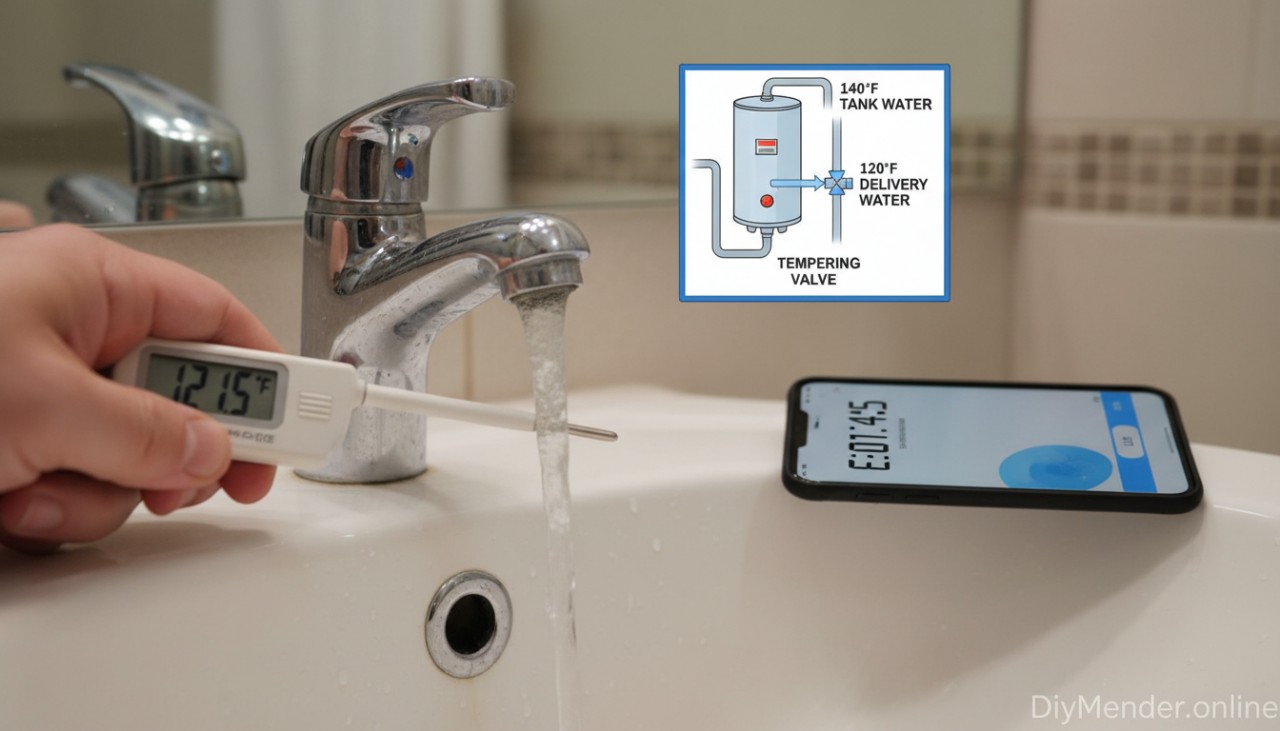
- Mixing/anti-scald valves: A thermostatic mixing valve at the heater (ASSE 1017) or at fixtures (ASSE 1070/1016) tempers hotter tank water down to a safer delivery temperature.
- Single-handle faucet behavior: Cartridges can bias toward lukewarm; scald-stop limiters may prevent the handle from reaching full hot.
- Tankless dynamics: Flow rate and inlet temperature control output; winter’s colder inlet water can drop faucet temps unless you reduce flow or raise the setpoint.
- Pressure and demand: Running other fixtures shifts mixing and can cool a faucet mid-use.
- Recirculation: A working recirculation loop delivers hot faster; a failed pump or check valve makes you wait and lowers measured peak.
How to measure faucet temperature accurately
I’ve tested dozens of sinks; the biggest mistake is using a laser/IR gun on shiny water or metal—those readings are unreliable. Use a probe thermometer or a cooking digital thermometer with an immersion tip.
- Close other hot-water fixtures.
- Run the hot side fully open and place the probe into the running stream in a mug or directly in the flow.
- Time to steady state: Note how long it takes to stop rising; record the max temperature and time.
- Test multiple spots: A nearby powder room might hit 120°F quickly, while an upstairs bath caps at 112°F due to long piping.
- Repeat after no use: First draw after hours shows true heat loss; a second draw shows recirculation or pipe-warmed conditions.
What’s safe, what’s code, and what about bacteria?
For daily use, 120°F at the faucet balances comfort and safety. Children and older adults are more vulnerable to scalds.
- Scald timeline (approx.): 120°F burns in 5–8 minutes, 130°F in ~30 seconds, 140°F in ~5 seconds, 150°F in 1–2 seconds.
- Many jurisdictions require 120°F max at bathroom lavatories via an anti-scald device. Kitchens often aren’t limited by code but still deserve caution.
- Legionella considerations: Some pros maintain 135–140°F in the tank to inhibit bacteria growth but temper down to 120°F at taps using a mixing valve. This gives you safety at the faucet without storing water “too cool” in the tank.
How to adjust faucet hot water (tank and tankless)
Tank-type water heater
- Gas: Turn the knob to “120°F” or roughly “Hot” (not “A/B/C” without a chart). Wait an hour, then retest at the faucet.
- Electric: Turn off power at the breaker. Remove the access panels and insulation; adjust both upper and lower thermostats to the same setting (around 120°F). Restore power, wait, and retest.
- If you need 140°F storage for Legionella control or a dishwasher, install/adjust a thermostatic mixing valve at the heater to deliver 120°F to fixtures.
Tankless water heater
- Set the unit to your target delivery (usually 120°F). If water feels cool, reduce flow at the faucet or use a low-flow aerator to keep the heater engaged.
- In winter, colder inlet water may require a higher setpoint or slower flow to hold temperature.
- Descale if temps fluctuate—mineral buildup insulates the heat exchanger and lowers output.
At the faucet or shower
- Check the scald-stop limiter on single-handle faucets and shower valves. Adjust to allow more hot travel, but verify the mixed outlet still stays near 120°F.
- If bathroom water is stuck below 110°F while the kitchen is fine, a point-of-use anti-scald/thermostatic valve may be set too low or failing.
Troubleshooting odd results
- Never reaches 110°F at distant sinks: Long uninsulated runs, a dead recirculation loop, or low water heater setpoint. Insulate hot lines, fix the recirc pump, or raise the setpoint slightly (then verify at taps).
- Gets hot then cools: Tankless below minimum flow, or another fixture opened causing mixing changes. Stabilize flow; clean aerators.
- Randomly scalding: Failed thermostatic mixing valve or worn faucet cartridge. Replace the valve/cartridge; don’t rely on handle “feel.”
- Apartment/condo with central boiler: Building tempering valves control delivery; report low or high temps to management rather than cranking your unit’s valves.
- Well water in winter: Very cold inlet lowers mixed temperature; consider a small recirculation loop or slightly higher setpoint with proper tempering.
Common mistakes to avoid
- Trusting IR thermometers on water or chrome. Use an immersion probe.
- Not running water to steady state before reading.
- Adjusting only one thermostat on a dual-element electric tank—set both the same.
- Removing anti-scald limits without checking actual temperatures. Always measure and keep around 120°F at lavatories.
When to call a pro
If you can’t achieve stable 115–125°F at sinks, see temperature swings, or suspect a failed mixing valve, have a plumber test with a calibrated thermometer and verify anti-scald devices (ASSE 1016/1017/1070). That’s a quick visit that buys both safety and comfort.
Bottom line: Aim for 120°F delivered at most sinks. Measure with a probe, adjust the heater and mixing valves, and fix the small mechanicals that make a big difference in how hot your sink water gets.