
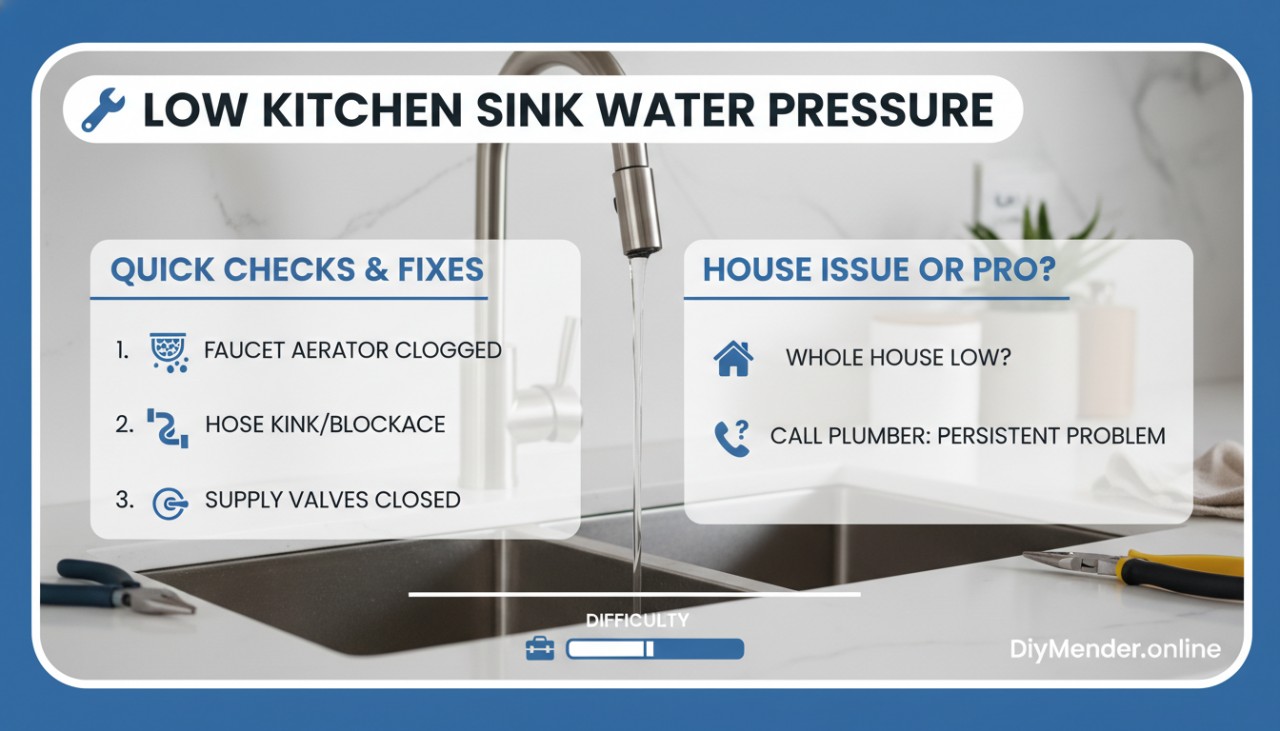
If you are asking why is the water pressure low in my kitchen sink, the fastest answer is this: in most homes, the cause is a clogged aerator or spray head, a partly closed shutoff valve, or a clogged faucet cartridge. Start by removing and cleaning the aerator or sprayer screen, make sure both under-sink shutoff valves are fully open, and compare hot vs cold. If other fixtures are fine, the problem is almost always in or right under the faucet, not your main water supply.
Why these fixes work: a faucet is a series of small passages and screens that amplify velocity at the spout. Any grit or scale reduces the flow path, which makes the stream look weak even though household pressure is normal. Partly closed valves and kinked hoses do the same thing by throttling flow before it ever reaches the faucet.
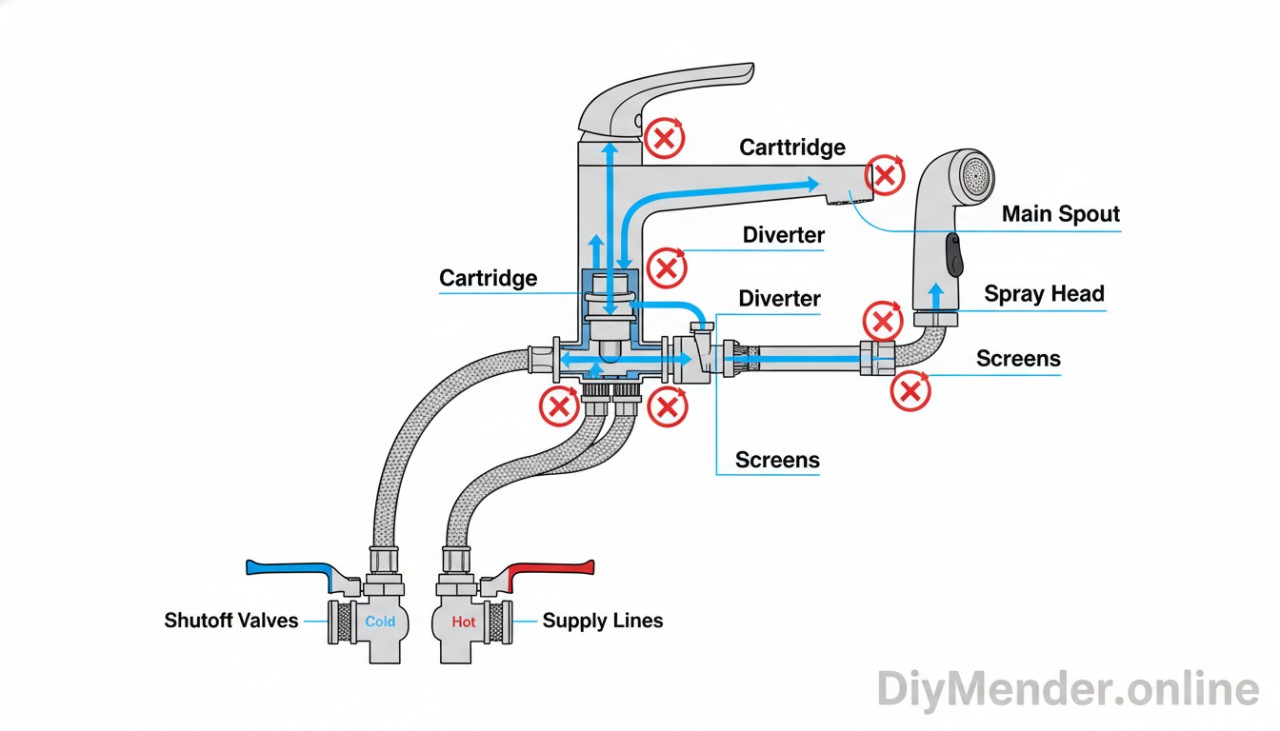
Quick 2-Minute Diagnosis
- Check other fixtures. If only the kitchen sink is weak, focus on the faucet. If everything is weak, check main pressure or a failed pressure regulator.
- Test hot vs cold separately. Run cold only, then hot only. Weak on one side means an issue on that side: shutoff, supply line, or heater debris.
- Unscrew the aerator or remove the pull-down spray head. Run water with the part off. Strong flow now means the aerator or head is clogged, not the supply.
- Look under the sink. Ensure both angle-stop valves are fully open and the flex lines are not kinked. Turn the oval handles fully counterclockwise.
- If you have a pull-down hose, check the counterweight. It should move freely and not pinch the hose on the cabinet wall or garbage disposal.
Why Each Fix Works
Aerator or Spray Head Screens
Aerators mix air with water by forcing flow through tiny holes. Mineral scale and sediment from municipal or well water accumulate here first because it is the smallest choke point. The result is low flow that looks like low pressure. Cleaning restores the original cross-section, so the faucet can pass full volume again.
How to fix: wrap the finish with tape to protect it, then unscrew the aerator or spray head by hand. Soak the parts in warm vinegar 30 minutes, brush with an old toothbrush, rinse, and reinstall. If the sprayer has a check valve or rubber backflow disk, make sure it moves freely after soaking.
Partly Closed Shutoff Valves
The under-sink valves throttle flow when not fully open. People bump them during storage or close them for a repair and forget to reopen fully. Even a quarter-turn shy can drastically cut flow because valve openings are not linear; most of the opening happens near the end of the turn.
How to fix: turn each valve fully clockwise to seat, then back counterclockwise to fully open. If a valve weeps or will not open smoothly, replace the angle stop rather than forcing it.
Kinked or Clogged Supply Lines
Flexible stainless or braided polymer lines can kink when the faucet is installed or when putting bins back under the sink. Kinks reduce the inner diameter and create turbulence that steals flow. Sediment can also lodge in the line or at the little screens on the faucet inlets.
How to fix: straighten kinks, or replace the line if a kink created a permanent flat spot. Inspect and rinse inlet screens if your faucet has them.
Clogged Cartridge or Diverter
Inside single-handle faucets, a ceramic cartridge meters hot and cold. Sediment lodges in its ports, especially after water heater maintenance or municipal line work. On models with a side sprayer or pull-down head, a small diverter valve redirects flow; its tiny passages clog easily.
How to fix: shut off water, plug the drain, disassemble the handle, pull the cartridge or diverter, and flush the body. Soak parts in vinegar if scaled. If seals are torn or the cartridge is gritty or stiff, replace. Always flush the open faucet body for 10 seconds before reassembly to purge grit.
Hot Side Only Weak
If cold is strong but hot is weak, the restriction is between the heater and the faucet. Common culprits include a partially closed hot shutoff, clogged hot supply line, debris from a failing water heater dip tube, or scale from high-temperature operation.
How to fix: open the hot stop fully, check the hot line, and flush the faucet. If several hot fixtures are weak, flush the water heater and inspect the anode and dip tube.
Common Mistakes That Make It Worse
- Overtightening the aerator or spray head. This can crush gaskets or crack threads, causing leaks or making the next removal miserable.
- Skipping a line flush. After removing an aerator or cartridge, always run water briefly to blow out grit before reassembly.
- Using pliers on finished parts without protection. Wrap with tape or use a strap wrench to avoid bite marks.
- Confusing flow with pressure. A gauge at an outdoor spigot may read 60 psi but a clogged faucet will still dribble. You are fixing restrictions, not household pressure.
- Ignoring pull-down hose internals. Many heads have two screens and a check valve; cleaning only the tip leaves the upstream screen clogged.
Edge Cases and Limits
- Old galvanized pipes. Internal corrosion narrows the pipe. If only the kitchen branch is galvanized, that run may need replacement. No amount of aerator cleaning will restore full flow.
- Water softener or filter issue. A clogged whole-house filter can cut flow at the kitchen first if it is the highest-demand fixture. Check filter differential pressure or service indicator.
- Pressure regulator failure. If whole-house pressure is low and showers are weak too, a failed PRV or closed main valve is likely. Typical household pressure should be about 50 to 70 psi.
- Side sprayer diverter stuck. On older two-handle faucets with a side sprayer, a stuck diverter will starve the spout whenever the sprayer was used last. Replace the diverter.
- PEX kinks behind walls. If a recent remodel added PEX, a hidden kink near the cabinet can restrict only the kitchen. A borescope inspection may be needed.
When It Is Not the Faucet
Run a pressure test at an exterior hose bib with a $15 gauge. If it reads below 40 psi and multiple fixtures are weak, you have a supply issue: municipal work, a stuck pressure regulator, a partially closed main valve, or a clogged whole-house filter. If pressure is fine but all hot taps are weak, focus on the water heater and hot trunk line.
Parts and Tools I Keep on Hand
- Replacement aerator and spray head O-rings and screens
- Universal single-handle cartridge for my faucet brand
- Two new braided supply lines in the right length
- Vinegar, toothbrush, silicone grease for O-rings
- Adjustable wrench, strap wrench, plumber tape, towels
When to Call a Pro
Call if you have galvanized supply lines, repeated sediment after heater flushes, valves that will not open or shut, or you are seeing brown grit after every repair. Those point to systemic issues, not just a faucet restriction. A plumber can measure dynamic pressure and flow, inspect the PRV, and camera the lines if needed.
Bottom line: most kitchen sink low flow problems are localized restrictions you can fix in minutes by cleaning the aerator or sprayer, fully opening shutoff valves, and flushing or replacing a clogged cartridge. If the weakness shows up across multiple fixtures, widen the lens and verify pressure and filtration before tearing into the faucet.