
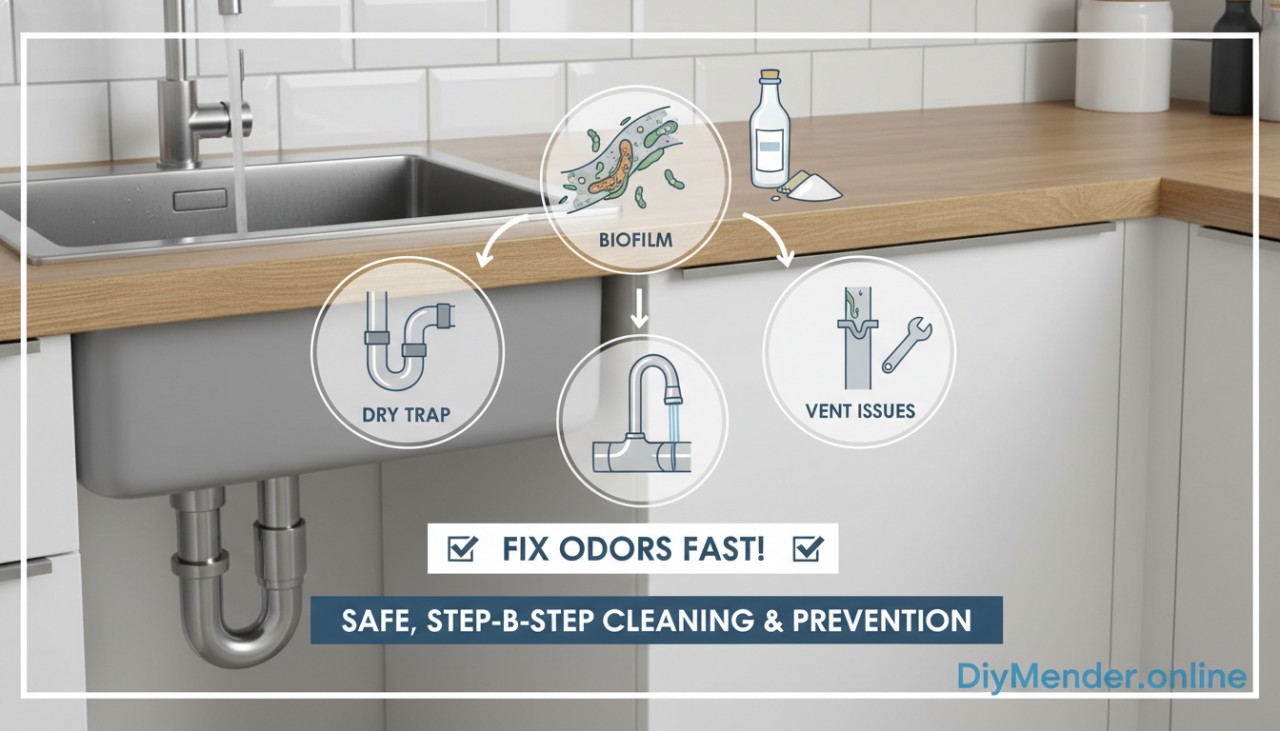
Here’s exactly how I make a sink drain smell better in my own house: scrub the parts you can reach, flush and refill the P-trap, then let enzymes eat the leftover biofilm overnight. This hits the three real causes of stink—rotting gunk, stagnant water, and sewer gas—and it works because you remove odor sources mechanically, restore the water seal, and let biology finish what chemistry can’t.
Quick diagnosis: which smell is it?
Before cleaning, I do a quick sniff test—it points me to the right fix and saves time.
- Rotten/food-funk (kitchen): usually biofilm in the strainer, disposal splash guard, or tailpiece.
- Eggy/sewer gas: dry P-trap, siphoned trap, or a vent/AAV issue letting gases in.
- Musty/drain-fly vibe: slime in the overflow channel (bathroom) or gunk coating pipe walls.
Most “miracle pour-ins” fail because they don’t touch the actual buildup or don’t fix a dry trap. Physical contact and a proper water seal are what stop odors.
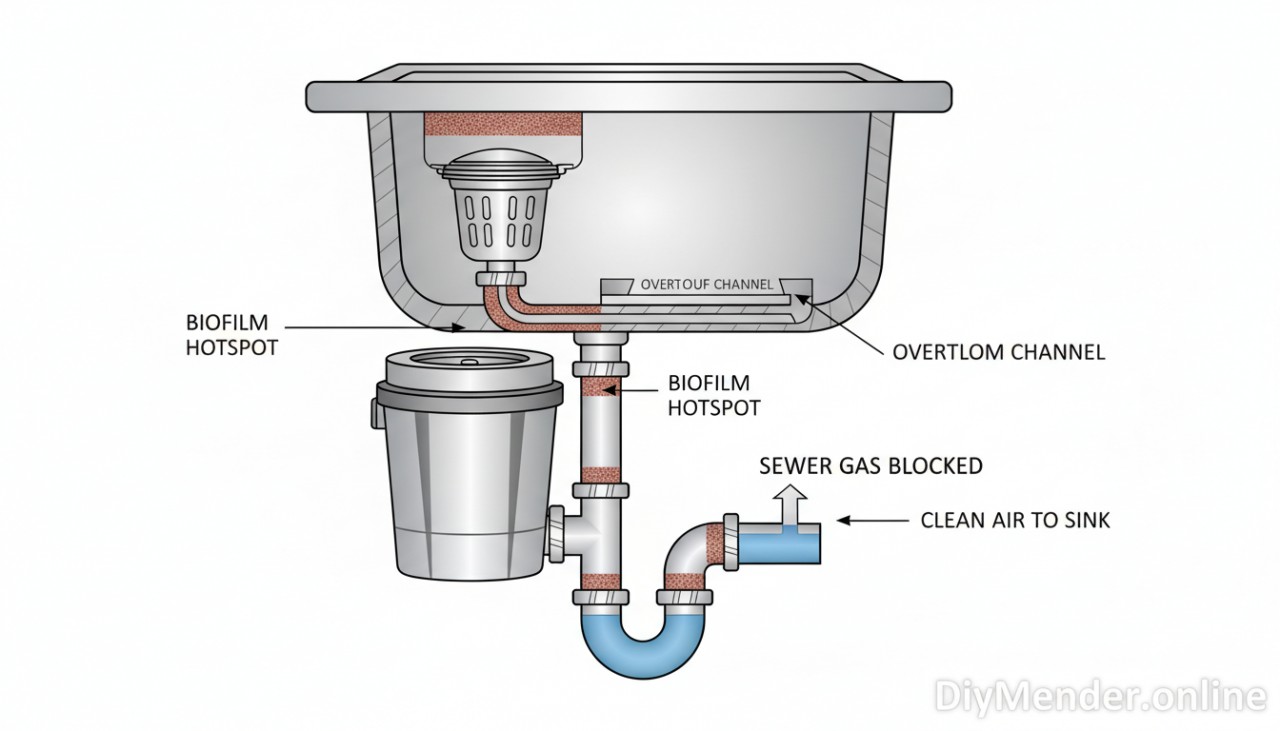
My 10-minute reset (works for most sinks)
- Pull the stopper/strainer and scrub it. That rubber ring and underside collect rank biofilm. I use a toothbrush and hot, soapy water.
- Brush the tailpiece. A skinny bottle brush or an old baby-bottle brush reaches 4–6 inches down—this breaks the stink mat that cleaners can’t dissolve.
- Boil a kettle and rinse carefully. A steady, brief pour melts grease. Caution: avoid repeated boiling-water dumps into old PVC, acrylic, or glued ABS—occasional use is fine, but constant shock can soften plastic or stress joints.
- Alkaline clean beats vinegar shows. I sprinkle 2–3 tablespoons baking soda, then add a small squirt of concentrated dish soap. After 5 minutes, I chase with very hot (not boiling) water. Why: the mild alkali + surfactants lift fats. Baking soda + vinegar foams, but that CO2 push can just relocate gunk deeper without removing it.
- Refill the trap. Run the faucet 10–15 seconds to ensure the P-trap has a full water seal; this blocks sewer gas.
- Enzyme overnight. Last thing before bed, I pour an enzymatic drain cleaner (septic-safe). Enzymes eat leftover organics along the pipe walls while the drain rests.
Next morning, run hot water for 30 seconds. If odor is 80–100% gone, you nailed it. If not, do the deep clean below.
Deep clean: when the smell fights back
1) Garbage disposal (kitchen)
- Scrub the black splash guard (under-sink baffle) on both sides—this is often the stink champion. You can remove it on many units and hand-wash it.
- Ice + coarse salt, then run the disposal with a trickle of cold water for 30 seconds. The ice scours the impellers; salt adds abrasion.
- Rinse and finish with a thin peel of citrus for scent only. Citrus doesn’t clean much; it just masks after you’ve actually removed the grime.
2) Overflow channel (bathroom sinks)
- Spray a foaming bathroom cleaner into the overflow holes, let it dwell, then flush with hot water.
- If still funky, feed a bit of enzyme solution into the overflow using a small funnel; let it sit overnight.
3) P-trap cleanout (when you need certainty)
- Place a bucket, loosen the slip nuts, and pull the trap. Scrub out sludge; reassemble with the nylon washers in the same orientation.
- Caution: old chrome-plated brass traps can be fragile; if threads are corroded, replace the trap instead of forcing it.
Why these steps work (the short science)
Odors live in biofilms—slimy matrices that protect bacteria. Mechanical agitation (brushing, ice), surfactants (dish soap), and dwell time (enzymes) break biofilms so water can carry away the debris. The P-trap’s standing water is a vapor seal; if it’s empty or siphoned, sewer gas flows freely. That’s why “masking” never lasts.
If it smells like sewer gas
- Check for a dry trap: Rarely used sinks evaporate. Run water for 15 seconds. To slow future evaporation, add a tablespoon of mineral oil to the trap—it floats and reduces evaporation.
- Watch for trap siphoning: If the sink gurgles after draining, negative pressure may be pulling the trap empty. That’s a venting issue.
- Inspect the AAV (air admittance valve): Under some sinks there’s a small valve on a vertical stub. If it sticks open or fails, sewer gas leaks. Replacement is simple and cheap.
- Persistent sewer odor after proper trap fill: you may have a mis-plumbed or cracked vent—time to call a plumber or smoke-test the system.
Mistakes I’ve learned to avoid
- Don’t mix bleach with anything acidic or ammonia-based (including vinegar). Toxic gases form.
- Go easy on boiling water into plastic piping and solid-surface sinks. Occasional is fine; habitual thermal shock isn’t.
- Avoid caustic drain openers in septic systems—they can kill beneficial bacteria and don’t remove biofilm well.
- Don’t rely on citrus peels or coffee grounds. Peels mask; coffee can accumulate and clog.
- Skip the “baking soda + vinegar volcano” as your main cleaner—it entertains more than it de-gunks.
Edge cases that masquerade as drain stink
- Dishwasher cross-odor: The dishwasher drain hose tees into the sink tailpiece. Food stink can backflow if the hose sags. Add a high loop or fix the air gap and clean it.
- Drain flies: If you see tiny moth-like flies, you’ve got slime deeper in the line. Enzymes nightly for a week plus physical brushing at the opening usually solves it.
- Old galvanized or cast-iron lines: Interiors can be rough and hold stink. Expect more frequent maintenance or plan for repipe down the road.
- Septic systems: Stay enzyme-forward; reserve bleach for rare disinfecting and flush with lots of water afterward.
Simple prevention that actually works
- Weekly: 30–60 seconds of hot water with a squirt of dish soap down the drain.
- Monthly: Pull and scrub the stopper/strainer and the disposal splash guard.
- Quarterly: Enzyme overnight. If rarely used, run water monthly and add a teaspoon of mineral oil.
- Right now: Make sure the dishwasher drain hose has a high loop or air gap to stop backwash odors.
If you follow the reset, your sink should smell neutral within a day. If the odor returns fast even after a proper clean and a confirmed water seal, you’re likely dealing with a venting/AAV fault or a partial obstruction trapping sludge downstream—both solvable, but they call for a closer look or a plumber’s snake.