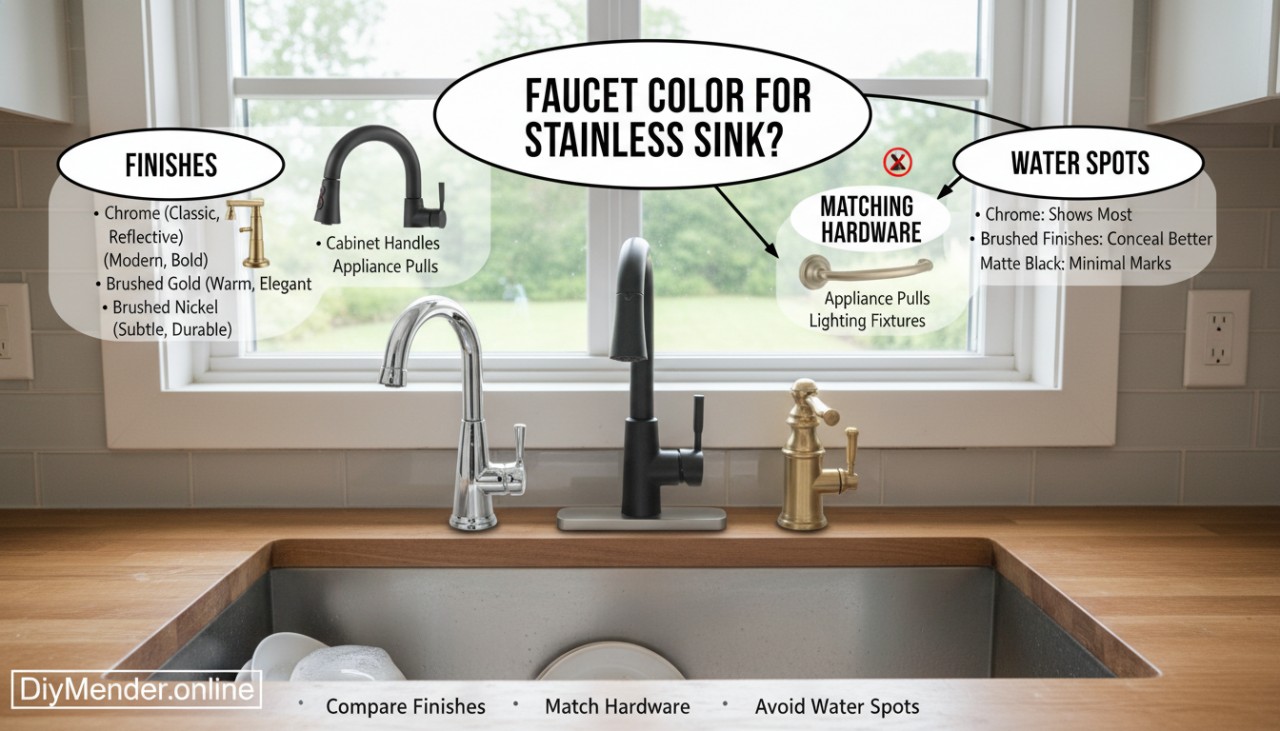
The fastest way to narrow this choice is to match your faucet to the sink’s sheen and your room’s hardware. If you’re weighing what color faucet for stainless steel sink, start by looking at three things: the sink’s finish (brushed or polished), the surrounding metals (cabinet pulls, appliances), and how hard your water is. Those decide whether fingerprints bother you, whether a high-contrast look works, and how much cleaning you’re signing up for.
Choosing what color faucet for stainless steel sink
In most homes, brushed finishes play nicest with stainless because they echo the grain and hide spots. But contrast can look great when done intentionally. Here’s how I make the call in real kitchens.
Match the stainless look when you want low maintenance
If the sink has a brushed surface (most do), brushed nickel or stainless-look faucets blend seamlessly and hide water spots and fingerprints. Chrome also pairs well visually with stainless but shows spots more. In busy kitchens or hard-water areas, I only choose chrome if the homeowner loves the sparkle and doesn’t mind frequent wipe-downs.
- Best for: consistency, resale-friendly look, minimal cleaning
- Watch out for: subtle tone differences between brushed nickel and your sink
Tip from experience: If your sink is bright and your faucet sample reads a little warmer or more matte, it can look mismatched under daylight. Check finishes in morning and evening light before deciding.
Go bold with contrast when the room needs a focal point
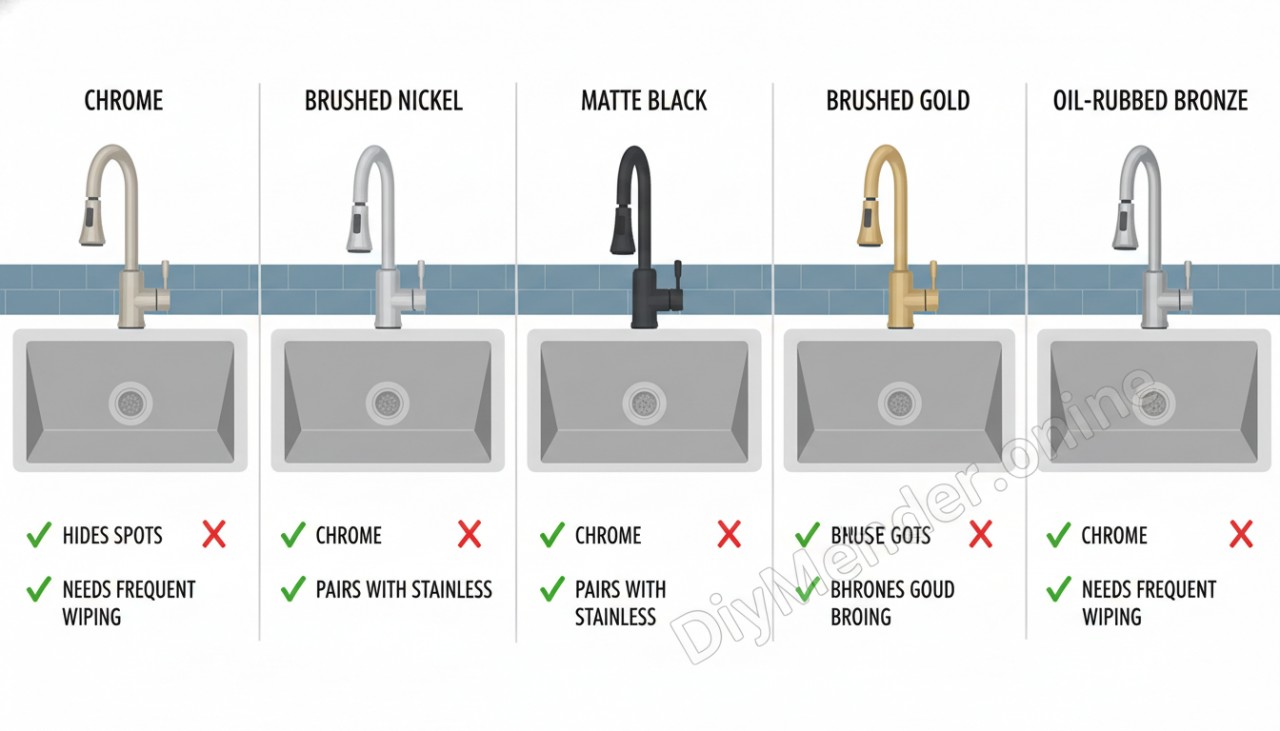
Matte black against stainless can look sharp in modern or industrial kitchens, especially with black pulls or dark grout. Brushed gold or champagne bronze warms up cool stainless and can tie together warm woods and soft-white walls. Oil-rubbed bronze suits farmhouse or rustic styles but shows wear on high-contact areas over time (which some people like).
- Matte black: dramatic, hides spots well; watch for soap residue rings if you have hard water
- Brushed gold/champagne tones: warm, upscale feel; make sure your lighting isn’t too cool or it may look brassy
- Oil-rubbed bronze: classic, but patina evolves; be okay with finish variation
Reality check: Contrast finishes look intentional only if they’re repeated. If the faucet is the only dark metal in the room, it may read like a mistake. Add matching knobs, a light fixture, or a frame to carry the color.
Consider the sink’s exact finish and edge
Stainless sinks vary. A brushed, soft-sheen basin forgives, while a polished sink mirrors every reflection and shows splashes. Polished sinks pair better with chrome or polished nickel for a cohesive shine. Top-mount sinks with a wider deck often look better with a finish that matches the deck tone; undermounts are more forgiving since the counter is the visual frame.
If your sink has a visible grain, brushed finishes echo that texture, making the faucet feel like part of the same family. With a hammered or textured stainless sink, lean brushed or antiqued finishes to avoid visual clash.
Test with your actual light and water
Two spaces with the same materials can feel totally different because of lighting and water hardness. Cool LED lighting (5000K) intensifies the blue in stainless and can make warm gold look off. Warm lighting (2700–3000K) flatters gold and makes chrome sparkle less harshly. Hard water amplifies spotting on chrome and dark finishes; brushed finishes are more forgiving.
- Bring home physical finish samples and hold them over the sink at night and during daylight
- Run the tap and let droplets dry on a sample faucet if possible to see spotting
- If you have a water softener, chrome becomes much easier to live with
Coordinate with what’s already fixed in place
Cabinet hardware and nearby appliances do more to dictate faucet finish than paint colors. If you’re not changing pulls, use them as your anchor.
- Stainless appliances + brushed nickel pulls: choose brushed nickel or stainless-look faucet
- Black pulls or black light fixtures: matte black faucet ties the room
- Warm brass pulls: brushed gold or champagne faucet; avoid bright, yellow brass unless the hardware matches
- Mismatched metals everywhere: pick one dominant metal for faucet and repeat it in at least one other spot
Countertops matter too. Cool white quartz with gray veining suits chrome, brushed nickel, or matte black. Warm quartzite, butcher block, or creamy stone often prefer brushed gold or bronze.
Cleaning reality by finish
Every finish has trade-offs. Plan for how you clean, not how you wish you cleaned.
- Chrome: highest shine, easiest to scratch if scrubbed; shows every spot; cleans up beautifully with a quick microfiber wipe
- Brushed nickel/stainless-look: hides fingerprints and spotting best; sometimes shows faint “streaks” if not dried after cleaning
- Matte black: hides fingerprints, may show mineral outlines; avoid abrasive pads that can make it glossy in spots
- Brushed gold/champagne: forgiving, but harsh cleaners can dull; use mild soap and water
- Oil-rubbed bronze: patina evolves; spot-clean gently and accept finish change as character
Pro tip: A small bottle of 50/50 vinegar and water near the sink makes quick work of mineral spots on most finishes (spray on cloth, not directly on the faucet). Check your faucet’s care guide before using acids on specialty finishes.
When mixed metals make sense
Mixing metals works if you follow a 70/30 rule. Let one metal dominate (often the faucet plus pulls), then use a secondary metal for accents like a pendant or picture frame. Stainless plus matte black is the easiest pair to pull off. Stainless plus brushed gold works when you repeat the warm tone at least twice.
If you’re nervous, consider a two-tone faucet where the body is one finish and the handle or spout cap is another. It bridges metals without committing the whole fixture to a bold color.
Common mistakes I see
- Choosing chrome with very hard water, then hating the spots a week later
- Picking a bold faucet color with no matching hardware or lighting to back it up
- Ignoring the sink’s sheen and ending up with clashing textures (polished faucet on a heavily brushed sink can look off)
- Testing finishes only under store lighting; everything looks different at home
- Ordering before checking return policies and restocking fees on special finishes
Real-world picks by scenario
- Modern condo, stainless appliances, white quartz, cool LEDs: matte black or brushed nickel
- Family home, hard water, brushed stainless sink, mixed pulls: brushed nickel to keep cleaning simple
- Warm farmhouse kitchen, wood counters, bronze hardware: oil-rubbed bronze or warm brushed gold
- Small galley kitchen needing brightness: chrome if water is soft; otherwise brushed nickel
Installation and compatibility notes
Before you fall in love with a finish, make sure the faucet style fits your sink and counter. Check the sink’s mounting holes (one, two, or three). If you have three holes and want a single-handle faucet, confirm it includes a deck plate in the same finish. If you have an undermount sink with tight backsplash clearance, a straight lever handle may hit the wall; consider a top-mount or forward-facing handle design.
For integrated sprayers and filtered water taps, ensure accessory finishes are available. A stainless faucet with a mismatched chrome air gap looks accidental—order matching accessories when you can.
Simple decision path to get it right
- Identify your sink’s sheen: brushed or polished
- List your fixed metals: pulls, appliances, lighting
- Note your water hardness and cleaning tolerance
- Pick either match (brushed nickel/stainless-look) or contrast (matte black/gold/bronze)
- Repeat the finish at least once elsewhere in the room
- Test samples in your actual lighting before buying
When to get a pro involved
If you’re swapping from a two-handle faucet to a single-hole or vice versa, or moving the faucet location, you may need a plumber to cap or reroute lines and to ensure the deck plate seals against splashes. For counters with hairline cracks around the faucet hole, a pro can add a proper gasket and backing plate so leaks don’t soak the cabinet over time.
Bottom line
If you want a safe, low-maintenance choice that blends in, choose a brushed nickel or stainless-look faucet. If your kitchen has black or warm brass accents and you’re okay with a bit of care, matte black or brushed gold can look intentional and stylish against stainless. Let your sink’s sheen, your fixed hardware, and your water hardness be the tie-breakers—and always test finishes in your actual light before committing.